
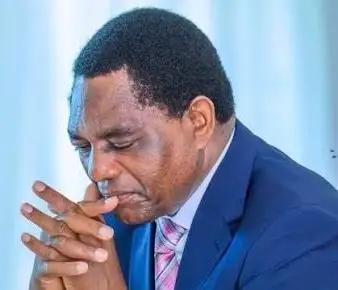
By Given Mutinta
THE SYSTEM HAS ALREADY EJECTED PRESIDENT HICHILEMA
There is a truth as old as governance itself: power is not held by those who wear the crown or occupy the highest office, but by the hands of the people who choose to hold it—or to take it away.
This is a saga that played out with ruthless clarity in Zambia’s recent political theatre, where President Edgar Lungu’s fall and President Hakainde Hichilema’s rise, and now his own imminent fall, reveal profound lessons about the fragile nature of power in a democracy.
Towards 2021 elections, the tides of power shifted dramatically. President Edgar Lungu, once the powerful custodian of Zambia’s presidency, found himself vulnerable not to a coup or a battlefield insurgency, but to the very system and people that had placed him in power in 2015 and 2016.
Details of his every move—from the crack of dawn until dusk—were leaked, monitored, and reported directly to Hichilema the opposition leader, signaling that the machinery of government had already started pledging loyalty to the incoming leader.
Hichilema himself unveiled the astonishing reality in a televised news conference, admitting he had access to intelligence reports before Lungu.
The presidency, once a fortress of secrecy and authority, had become a transparent stage where control slipped silently from Lungu but irrevocably away to Hichilema.
This was not mere political intrigue; it was a striking revelation that power Lungu had was neither a personal possession nor a birthright.
Instead, his presidency was at the mercy of the system’s allegiance, and more poignantly, the people’s will.
The intricate web of loyalty within government—ministries, security agencies, advisers—shifted from Lungu like sand when the people’s verdict was cast even before the vote itself was cast.
The system, ever pragmatic, leaked information to Hichilema not out of hatred for Lungu, but to protect its continuity, secure jobs and futures by aligning with the power it saw as incoming.
History, in its relentless cycle, now reveals that President Hichilema, who, for five years, basked in the glow of newfound authority, faces the same trajectory as his predecessor.
The whispers in governmental halls grow deafening, the confidential and private nature of his presidency has completely eroded, and soon the entire apparatus of the state pivot away from him as well.
From sunrise to sunset, President Hichilema’s words and actions are relayed to the next government – an informal tradition within the system. He is constantly on the radar since his presidency is up.
The truth is cruel: once the people have decided to bring about change, no president, however resolute, can hold onto power with a system that has already ejected them.
Look back at the names etched into Zambia’s political annals—Kenneth Kaunda, Frederick Chiluba, Rupia Banda, and Edgar Lungu—leaders who were embraced by the system only to be inevitably ejected.
Their tenure, regardless of ambition or determination, was ultimately subject to the people’s final say.
That is the way it is that the incoming administrations inherit a system realigned and remobilized, leaving the outgoing president isolated, exposed, and stripped of the invisible shields of confidentiality, privacy and loyalty.
This interplay is a stark warning not only to President Hichilema, but also to future residents of State House that: it is dangerously futile for any president to resist the system’s reconfiguration once the owners of power, the people, have spoken.
Any attempt to cling to office against this current risks plunging the nation into instability and conflict.
As Ecclesiastes 3 reminds us, “There is a time for everything—time to be sworn in and time to hand over power.”
In a democracy like ours, the transition is not just a formality; it is the very essence of its survival.
For President Hichilema, the path forward demands humility and foresight—a recognition that when the system subtly but unmistakably signals an unravelling of loyalty, the wise leader prepares not for a battle of descent but for an honorable exit.
It is a lonely passage, marked by the solitude of relinquished power, yet it is the crucible through which democracy proves itself resilient and enduring.
In the end, power remains in the hands of the people, who wield it invisibly but with irrevocable force.
Their voice shapes not only who rises but also who must step down.
The presidency, therefore, is a temporal gift—a stewardship granted and withdrawn by the collective will of a nation determined to shape its destiny. And in that eternal exchange, democracy breathes, evolves, and endures.