
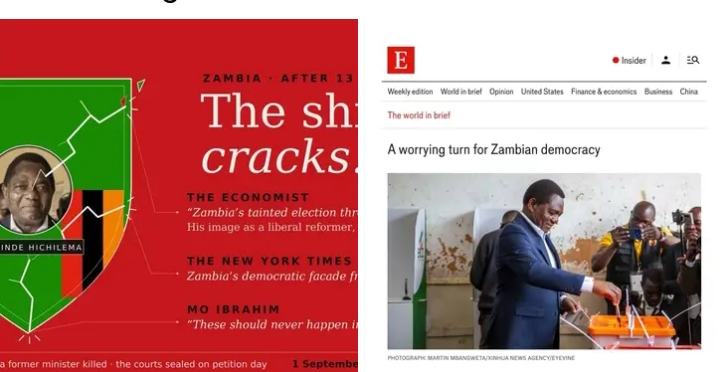
The shield cracks: what the Economist, the New York Times and Mo Ibrahim just told the world about Hichilema
A president once too favoured to be criticised is losing the audiences his image was built for, in Western capitals and now on the continent itself.
By Ambassador Emmanuel Mwamba
For five years, Hakainde Hichilema held the rarest asset available to an African incumbent: the benefit of the doubt in London and New York. It survived the arrests of critics. It survived the abductions that Zambian civil society documented and Western capitals declined to dwell on. It survived, until this month, more or less everything. In the space of a single August week, it has begun to give way.
The Economist has published three pieces on Zambia since the vote of 13 August: one on a strange election, one under the headline that the tainted election threatens the country’s reputation, and a brief on the sealing of the courts. The New York Times has reported that Zambia’s democratic facade is fracturing. These are not activist newsletters or diaspora blogs. They are the two publications most likely to sit on the desks of the investors, lenders and foreign ministries that Mr Hichilema has spent his presidency courting. When they turn, the shield turns with them.
It is worth recalling how the shield was built. Mr Hichilema came to office in 2021 as the former political prisoner who defeated a perceived authoritarian incumbent, the democrat vindicated, the reformer who would reverse the region’s slide. The image was not entirely false. It was also not entirely organic. In July, the investigative organisation Global Witness published a thirty-six page report alleging that First Quantum Minerals, the Canadian mining giant that dominates Zambian copper, and its associates had conducted a two-decade influence campaign over Zambian democracy. Sources told Global Witness the company had become the largest funder of the President’s party ahead of this election, with one former employee describing a willingness to spend as much as fifty million dollars, in a period when the administration granted mining tax concessions independent analysts valued at some seven hundred and seventy-one million dollars. The report also described the machinery of image: a British strategy firm, SABI Strategy Group, said to have run the President’s social media operations since 2015, and campaign figures reported to be working from State House itself.
First Quantum denies funding the party at all and the named consultants dismiss the report as conspiracy theory. Readers and particularly Zambian voters can weigh them for what they’re worth. But the report explains something that the events of August have now tested: Mr Hichilema’s international standing was never simply a reflection of his governance. It was a managed product, professionally maintained, generously financed, and it worked for as long as the facts stayed manageable.
Since 13 August, the facts have stopped cooperating. Consider only what the two papers have printed. The Economist reported that the electoral commission suspended the count the day after polling, that when tallying resumed the European Union’s observers found the situation had deteriorated significantly, that returning officers appeared to wait for instructions from the commission’s headquarters, and that the armed forces kept a heavy presence at the centres where votes were added up. It reported the churches’ monitoring group finding that votes were added to the President’s tally in thirty of the country’s two hundred and twenty-six constituencies, lifting his score by around four percentage points, something never observed in a Zambian election since independent verification began in 2001. It reported that senior officials denied for five days that a former cabinet minister had been shot in the raid on the opposition leader’s home, until the police admitted he was dead. The Times reported the United Nations human rights chief urging Zambian authorities to stop arresting people arbitrarily, and an opposition lawyer counting some forty detained supporters unaccounted for. Then, this week, came the detail neither paper could have invented: every court in the country closed, indefinitely, on the final day for challenging the result.
Neither publication endorses the opposition’s claim to victory. That should worry State House because criticism that concedes the strongest point available to the government and still finds the election tainted cannot be dismissed as opposition propaganda. It is the verdict of institutions with no candidate in the race, reached on the evidence of the state’s own conduct: the suspended count, the soldiers at the tally centres, the inflated returns, the concealed killing, the sealed courts.
The Economist drew the conclusion in its own voice: the election will likely force a reassessment of Mr Hichilema’s credentials as a relatively liberal leader, and Zambia’s messy election is another sign of democratic norms eroding. For a president whose entire international proposition has been that he is the exception to that erosion, there is no more damaging sentence in the English-speaking press.
And the alarm is no longer only Western. On 26 August, Mo Ibrahim, founder of the foundation that produces Africa’s foremost governance index and awards the continent’s most prestigious leadership prize, addressed the President directly and in public. The arbitrary arrest of opposition members, the killing of a former minister and the suspension of vote counting, he wrote, “should never happen in a true democracy”, and the closure of Zambia’s top courts just before the challenge deadline only compounds the disorder. He ended with a warning to Mr Hichilema that a legacy built over decades, long showcased as a model for the continent, could crumble now, and that it would be a shameful waste. When the African establishment’s own arbiter of governance says this over his own name, the last available defence, that criticism of Lusaka is foreign meddling, loses its foothold.
Other stakeholders should treat this coverage as the alarm it is. The development agencies that fund governance programmes in Lusaka, the creditors and multilateral lenders whose programmes assume a rule-of-law state, the mining investors reassured by talk of stability, the democracy summits that offered Mr Hichilema their stages: all of them relied, to some degree, on an image that the world’s most careful publications have now stopped underwriting. The events since 13 August are not a communications problem awaiting better management. They now are a documented record, and every week of silence from those who once celebrated Zambia’s democratic exception adds their names to the story of how it was lost.
The machinery that built the image will attempt repairs. Global Witness has already named its principal engineers: Henry Sands, a former director of the CT Group, whose firm SABI Strategy Group is reported to have run Mr Hichilema’s social media operations since 2015 and to be directing his 2026 campaign from State House itself, and Greg Mills, the former head of the Brenthurst Foundation, reported to be working alongside him. Both are embedded in Britain’s information establishment. Sands is the son of a former editor of the Evening Standard. Mills holds positions at the Royal United Services Institute as a Senior Associate Fellow and advisory board member. From perches like these the repair work will come: columns about stability, investment and reform, and consultants paid to place them.
But a nationwide shutdown of the judiciary photographs the same in every language, and the two global papers that matter most to Mr Hichilema’s audience have already published the picture. The shield did not crack because his critics grew louder. It cracked because the facts became indefensible, and because, at last, someone with a global platform looked.
And the looking has only begun. No one can say what further revelations wait behind the slipping mask of Africa’s newest strongman, but the damage already visible, to Zambia’s institutions and to its standing in the world, should trouble even Mr Hichilema’s most ardent supporters, at home and abroad. They, more than anyone, were promised something better.