
We don’t know those Persons With Disability say Disability Organisations
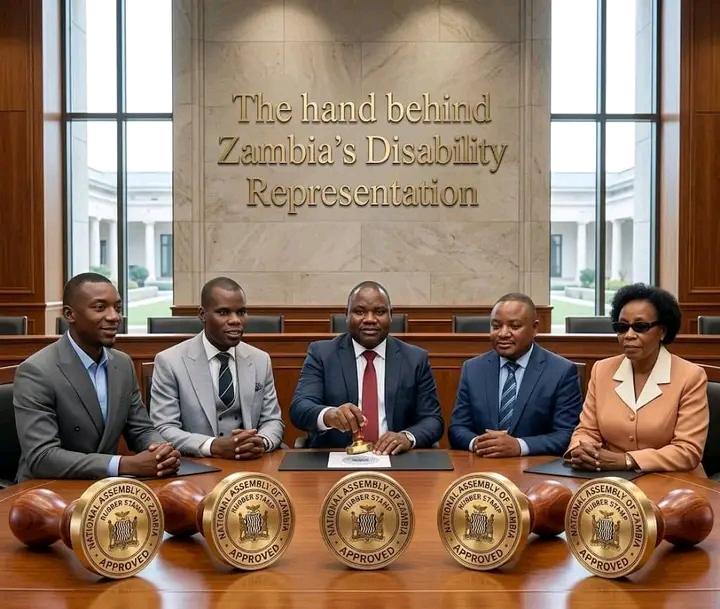
FIVE RUBBER STAMPS FOR PARLIAMENT? THE STATE HOUSE HAND BEHIND ZAMBIA’S DISABILITY REPRESENTATION
By EMV Staff Reporter
ZAMBIA’S historic experiment with proportional representation for persons with disabilities was supposed to be a moment of liberation, dignity and democratic inclusion. Instead, what is emerging from the corridors of power is raising a far more disturbing question: Has the first opportunity to give persons with disabilities a genuine voice in Parliament been turned into an exercise of political patronage designed to manufacture five compliant voices?
Information reaching our desk from sources who claim knowledge of developments around State House alleges that Presidential Affairs Minister Levy Ngoma has been assigned to assist, coordinate or facilitate matters involving some of the persons selected to occupy the five parliamentary seats reserved for persons with disabilities.
These allegations have not been independently verified, and Mr Ngoma and State House should be given an opportunity to respond. But if such involvement exists, the public has every right to ask a fundamental question: Why should a political establishment be involved in ensuring that disability representatives become politically convenient rather than genuinely independent representatives of the disability community
This question becomes even more uncomfortable because Zambia did not create these five seats so that the Executive could manufacture a friendly disability caucus in Parliament. The constitutional reform created five seats specifically for persons with disabilities, while the Electoral Process Amendment Act requires disability party lists to contain alternates of the classes of disabilities and requires candidates to possess certificates of registration under the Persons with Disabilities Act.
The African Union and COMESA election observation mission has itself noted that while Zambia’s new system advances participation by persons with disabilities, the law does not prescribe how political parties should select their disability candidates, leaving that process largely to party leadership. That gap in the law makes political transparency even more important.
The question facing Zambia today is therefore not whether persons with disabilities should be represented in Parliament. They absolutely should. The question is whether the five people selected genuinely represent the diversity, struggles, aspirations and independence of the disability movement, or whether political parties have simply found five individuals whom they believe will not cause trouble.
The names now under intense scrutiny are Kennedy Phiri, Dongo Mubanga Mumba, Lazarus Hakalebula, Francis Kopa and Misheck Mweemba.
Let us be clear from the beginning: acquiring a disability later in life does not make a person less of a person with a disability, and it does not automatically disqualify anyone from public office. The issue is representation, experience, independence, compliance with the law and whether the selection process was transparent.
Kennedy Phiri is described as a former football coach in Chipulukusu Compound in Ndola who later served as a councillor and remained involved in football administration. Accounts circulating about his disability say that he acquired it as an adult following a railway accident. The disability community is not questioning his humanity. The question is whether the political process that selected him properly considered the different classes of disabilities and the need for broad representation.
Dongo Mubanga Mumba is similarly described as having acquired blindness later in life following chronic illness. Information reaching our desk claims that she has only recently been learning Braille and is still developing proficiency in it. Again, this does not mean that someone who acquires blindness later in life cannot represent blind people. It does, however, raise a legitimate question about the experience and advocacy criteria used by the political parties when compiling their lists.
Then comes Lazarus Hakalebula, who has reportedly lived with blindness since childhood. His case raises a completely different question concerning his educational credentials. Allegations have reached our desk that there may have been intervention by people connected to State House concerning his Grade 12 certification and that arrangements may have been made involving officials connected to the examination system. These are serious allegations and must not be treated as proven without documentary evidence.
There is, however, a very simple way to silence the allegations: publish the records. If Mr Hakalebula legitimately obtained his Grade 12 qualification, let the relevant examination records demonstrate it. If he resat subjects, the examination sitting, registration and certification records should be capable of verification. The public deserves facts, not political whispers.
Francis Kopa raises another politically sensitive question. He has been associated with the UPND National Management Committee, and critics therefore argue that his nomination may be connected to his political loyalty. That is an allegation, not an established fact. But it is precisely because he is politically connected that the public deserves a clear explanation of the criteria that led to his selection.
More seriously, allegations have circulated that his disability registration was obtained on 14 April 2026 and that the card describes him as severely disabled. Critics have questioned whether that classification accurately reflects his condition. That too must be independently verified. A disability can be invisible, and nobody should determine disability severity merely by looking at a person. But if an official disability certificate is being challenged, the proper answer is not political intimidation or silence. The proper answer is verification by the competent authority.
Then there is Misheck Mweemba, whose disability documentation has also come under scrutiny. Information reaching our desk alleges that his disability card carries a registration date of 26 February 2019 but bears the signature of a Director General who allegedly only assumed office at the agency years later. If that allegation is accurate, it demands an explanation. Was the document subsequently reissued? Was the signature applied during an administrative update? Was there a clerical error? Or is there something more serious that requires investigation?
Again, the solution is simple: open the records.
But the biggest question is not even about individual disability certificates.
It is about political independence.
If Zambia has created five parliamentary seats for persons with disabilities, what happens when the Government introduces a policy that the disability community opposes?
What happens when the national budget reduces funding for disability programmes?
What happens when public buildings remain inaccessible?
What happens when persons with disabilities are denied employment?
What happens when Government agencies fail to implement disability legislation?
What happens when the Zambia Agency for Persons with Disabilities is underfunded or poorly governed?
What happens when the disability community takes a position that is politically inconvenient to the President?
Will these five representatives stand with the disability community, even when doing so means standing against Government?
Or will they simply follow the party line?
That is where the rubber meets the road.
A parliamentary representative who cannot challenge the Government that facilitated his or her political rise is not the kind of representation the disability movement has fought for over decades.
The disability movement did not fight for five decorative seats.
It did not fight for five parliamentary ornaments.
It did not fight for five people whose principal responsibility would be to applaud Government.
It fought for voice, dignity, accountability, equality and power.
And if the allegations reaching our desk about political coordination from State House are accurate, then Zambia may be witnessing something deeply ironic: a constitutional reform designed to empower a historically excluded community could be turned into an instrument for controlling that very community.
The allegations concerning Levy Ngoma therefore deserve a direct answer.
Has Levy Ngoma been assigned by State House to assist, coordinate or facilitate the affairs of the five disability representatives?
If the answer is no, let State House say so clearly.
If the answer is yes, what exactly is the nature of that assignment?
Was it administrative?
Was it political?
Was it merely logistical?
Who authorised it?
And why does the Executive need to be involved in the affairs of supposedly independent parliamentary representatives?
These are reasonable questions in a democracy.
They become even more reasonable when the Electoral Commission of Zambia has already validated the 40 proportional-representation members, including five persons with disabilities.
The historic reform was presented as a mechanism to guarantee representation for women, youths and persons with disabilities. Parliament records that the constitutional changes created 40 proportional-representation seats, including five for persons with disabilities.
So the five disability seats should now become a test of whether Zambia’s democratic reforms are about genuine inclusion or simply about expanding the political establishment’s influence.
The most disturbing possibility is not that some of the five may have acquired their disabilities later in life. That argument would be unfair and discriminatory.
The disturbing possibility would be if disability representation was deliberately reduced to political loyalty.
That is the issue.
The disability community needs representatives who can disagree with the President.
It needs representatives who can question ministers.
It needs representatives who can challenge political parties.
It needs representatives who can defend people with disabilities even when the people they are defending are politically unpopular.
It needs representatives who understand that their mandate does not come from State House.
Their mandate comes from the disability community and from the constitutional promise of inclusion.
If these five representatives are truly independent, let them prove it.
Let them speak for themselves.
Let them challenge Government when necessary.
Let them demand transparency over disability funding.
Let them demand accessible infrastructure.
Let them fight for inclusive education.
Let them demand employment opportunities.
Let them challenge discrimination.
Let them defend persons with disabilities who disagree with the Government.
Let them demonstrate that they are not anybody’s rubber stamps.
And if the Government believes the nomination process was clean, let it release the criteria used by the political parties and allow the public to understand how the candidates were selected.
If the disability certificates are legitimate, verify them.
If the academic qualifications are legitimate, verify them.
If the alleged State House involvement is false, deny it.
If Levy Ngoma has no political role in assisting the five representatives, say so.
If there is nothing to hide, transparency should not be frightening.
President Hakainde Hichilema should also understand that genuine disability representation is not a threat to his presidency.
A President who is confident in his policies should be able to tolerate five independent disability representatives who occasionally disagree with him.
The constitutional reforms were not designed to create a Parliament where everybody sings the same song.
Democracy requires disagreement.
Parliament requires scrutiny.
Representation requires independence.
And persons with disabilities deserve representatives who can stand upright , politically and morally, even when the Government does not like what they are saying.
The accusation that President Hichilema personally wants five “rubber stamps” in Parliament is a serious political allegation and should therefore be tested against evidence rather than treated as established fact. But the concern surrounding the selection process is legitimate enough to demand answers, particularly because the law gives political parties substantial discretion in selecting their lists.
This is therefore a moment for the disability movement to refuse silence.
The five seats belong neither to UPND nor NRPUP.
They do not belong to State House.
They do not belong to Levy Ngoma.
They do not belong to President Hakainde Hichilema.
They belong to the democratic project of representing persons with disabilities.
And if the people occupying those seats become nothing more than political echoes of those who selected them, then Zambia will have achieved representation in numbers while losing representation in substance.
The country must not celebrate five disability MPs merely because they are physically sitting inside Parliament.
The real question is whether, once inside that chamber, they will have the courage to stand when the disability community needs them to stand, speak when the disability community needs them to speak, and say NO when those in power need to hear NO.
That is the real test.
And that is why the public is entitled to ask:
WHO CHOSE THE FIVE, AND WHO WILL THEY REALLY SERVE?
Because if Zambia’s first five disability representatives enter Parliament already politically indebted to the people who selected them, then the country may have created five seats for persons with disabilities without actually creating five independent voices for persons with disabilities.
And that would be the greatest betrayal of the promise behind this historic constitutional reform.