
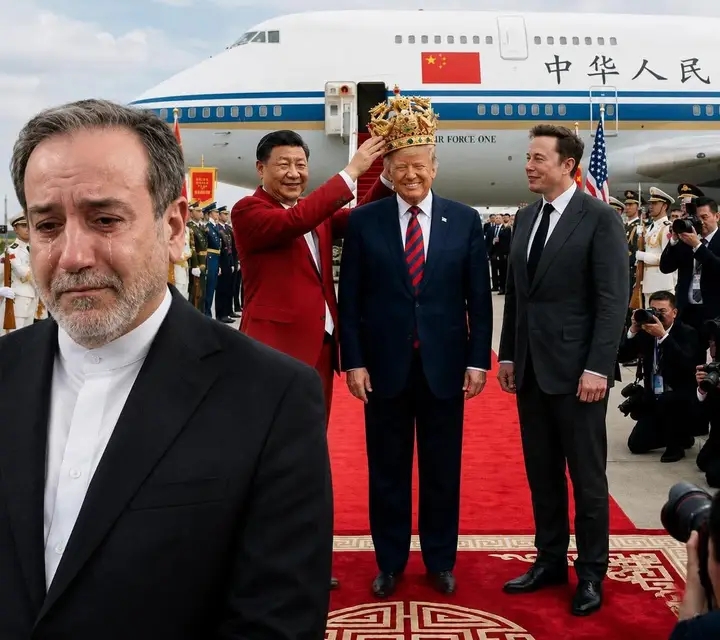
THE IRGC’S STRATEGIC NIGHTMARE: WHEN EVEN CHINA STEPS BACK
THE IRGC’S STRATEGIC NIGHTMARE: WHEN EVEN CHINA STEPS BACK
For years, Iran’s leadership and the IRGC built their geopolitical strategy on one dangerous assumption: that powerful allies like China and Russia would always stand firmly behind them no matter how reckless their actions became.
But global politics is not built on emotion, slogans or revolutionary speeches. It is built on interests.
And suddenly, Tehran is discovering a painful truth: Even allies have limits.
The recent high-level engagements between China and the United States have sent shockwaves through Iran’s ruling establishment. Reports emerging from the Trump-Xi discussions indicate growing consensus on two major issues: The Strait of Hormuz must remain open. And Iran must never obtain nuclear weapons.
This is devastating for the IRGC.
Why? Because for years the Iranian regime believed the Strait of Hormuz was its ultimate pressure weapon, a choke point it could threaten whenever tensions escalated. The regime constantly projected the image that global powers, especially China, would tolerate or even quietly support such tactics because of their dependence on Middle Eastern oil.
But reality is now colliding with propaganda.
China’s economy depends heavily on stable energy flows and uninterrupted trade routes. Nearly half of China’s crude oil imports pass through the Strait of Hormuz. Beijing may oppose certain Western sanctions and maintain economic ties with Tehran, but China also understands that chaos in Hormuz threatens its own economy directly.
This changes everything.
The IRGC expected solidarity. Instead, they are seeing pressure. The symbolism alone is extraordinary: A Chinese leadership that once positioned itself as Iran’s strategic counterweight to America is now openly engaging Washington on preventing escalation and ensuring Iran never becomes nuclear armed.
That does not mean China has suddenly become America’s ally. Far from it. China and the United States still remain deeply divided over Taiwan, trade wars, sanctions, military influence and global dominance.
But Iran is learning a brutal lesson: When superpowers negotiate global stability, smaller powers can quickly become bargaining pieces.
For the IRGC, this is more than diplomacy. It is strategic isolation.
The regime spent decades funding proxy militias, threatening Israel, destabilising neighbouring countries and building a revolutionary network stretching across the Middle East. They believed China’s economic partnership and Russia’s geopolitical hostility toward the West would shield them indefinitely.
Yet now the cracks are visible.
Even analysts sympathetic to China acknowledge Beijing is reluctant to fully sacrifice its global economic interests for Iran’s ambitions.
And this is where Tehran’s greatest miscalculation becomes visible: Iran confused transactional alliances for unconditional loyalty.
The world’s major powers do not operate based on ideological friendship. They operate based on survival, trade, energy security and national interest. If supporting Iran becomes too costly economically or politically, those alliances weaken rapidly.
That is exactly what appears to be unfolding now.
The message being sent to Tehran is becoming clearer: No closure of Hormuz. No nuclear weapon. No endless escalation.
For the IRGC leadership, this is humiliating.
Because the very pressure strategy they used for years may now be collapsing under the weight of global economic reality and shifting geopolitical priorities.
The world is entering a dangerous new era where alliances are fluid, interests are shifting and nations are recalculating their positions rapidly.
And Iran is beginning to discover that even its strongest partners may not be willing to go down with the ship.
Shalom
Pastor Thom