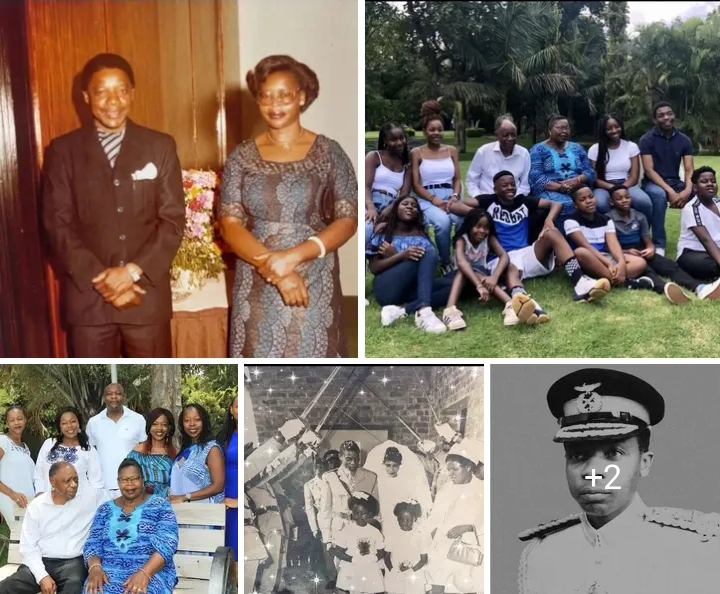
The Diplomat General. The Story of Lieutenant General Benjamin Ndabila Mibenge.
By Colonel Martin Kalaluka Liyungu
Today we remember Late Lieutenant General Benjamin Ndabila Mibenge in his birthday month.
True leaders do not just build careers, they build nations. Long before he was known across Africa as the “Top Soldier,” Benjamin Ndabila Mibenge was just a young boy growing up in Zambia, born on 22 June 1942, into a world poised for profound transformation. His parents, Mr. Joseph Bweupe Mibenge and Mrs. Maria Chimango Mibenge, watched as their bright son recognized early on that education and self discipline were the keys to unlocking a meaningful future.
As a young student, Benjamin possessed a sharp intellect and a striking natural trait, he was completely left handed. However, when his path led him toward military service, the Army insisted on uniformity. Demonstrating the immense adaptability that would define his life, he successfully transitioned from his natural left handedness to become right handed.
The late Lt Gen Mibenge attended the historic Munali Secondary School in Lusaka, completing his GCE O’Levels in 1963. His keen mind and natural leadership traits quickly caught the attention of military selectors. That very year, he left for the United Kingdom to attend the prestigious Royal Military Academy, Sandhurst. Graduating in 1965 as a Second Lieutenant, he stood alongside lifelong peers like General Kingsley Chinkuli and the Late Lieutenant Colonel Dunstan Santa Kasote. Together, Mibenge, Chinkuli, and Kasote became the “Big Three” pioneers, the foundational figures who formed the absolute bedrock of the indigenous Zambian Army Officers’ Corps immediately following the nation’s independence.
Returning to a newly independent Zambia, Lt Gen Benjamin Mibenge was ready to defend its sovereignty, shape its future, and serve as a proud founder of the Zambia Army Infantry Corps.
Upon his return, Lt Gen Mibenge’s mother unit was the 3 Battalion of the Zambia Regiment. He was a highly articulate writer, a unique ability that soon caught the attention of senior officers and led to his recruitment as a member of military intelligence.
Admired by officers and soldiers alike for his exceptionally smart turnout, General Mibenge’s military career became a masterclass in rapid promotion, earned entirely through competence, tactical brilliance, and an unwavering commitment to his troops.
Between 1965 and 1971, he mastered both field and staff operations. This dedication culminated in him being posted to the Second Battalion Zambia Regiment the elite ceremonial guard responsible for providing the prestigious State House Sentry Platoon which He played a part in modernising to what is known today.
As geopolitical tensions flared across Southern Africa due to fierce liberation struggles, the weight on his shoulders grew. He rose from Brigadier General and Chief of Army Staff in 1971 to 1976, to Major General and Chief of Inspectorate from 1976 to 1977.
By 1978, as Deputy Chief of General Staff, he was coordinating the complex, interlocking operations of the Army, Air Force, and National Service. His military ascent reached its absolute peak in 1979 when he was appointed Commander and Chief of General Staff of the Zambia National Defence Force (ZNDF), holding the rank of Lieutenant General.
At the height of the Rhodesian liberation war, late Lt Gen Mibenge carried the immense weight of national security, proving that true strength lies in calm, strategic focus during times of crisis.
Lieutenant General Mibenge’s leadership was never confined to the barracks; he was a master problem solver capable of turning chaos into order. Recognizing his logistical genius, President Kenneth David Kaunda seconded him to serve as the General Manager of the Tanzania-Zambia Railway Authority (TAZARA) during a critical operational bottleneck.
In a brief but historic tenure, late Gen Mibenge achieved what many thought was impossible. He successfully negotiated and signed the crucial Zambia Railways/TAZARA Operations Agreement, breaking a long standing deadlock between Zambian managers and Chinese railway experts.
But his leadership was tested on the ground, too. When a massive strike threatened to completely paralyze the railway line at Mpika, Lt Gen Mibenge didn’t hide behind a desk. He walked directly into the conflict, defusing the strike with deep empathy and firm leadership. Furthermore, his technical foresight led to vital structural modifications of the railway wagons, ensuring they could safely navigate the tight, curved tracks of the Copperbelt.
He proved to the world that a great leader listens, adapts, and builds bridges both literally and figuratively.
After retiring his Army uniform, late Lt Gen Mibenge answered a new call, to represent Zambia on the global stage. His subsequent diplomatic career was a masterclass in international relations.
He served as High Commissioner to Canada, Cuba, and the British Caribbean from 1981 to 1985, before being appointed Ambassador to Ethiopia, the Organisation of African Unity (OAU), and the United Nations Economic Commission for Africa from 1985 to 1990.
In Addis Ababa, his peers recognized his profound empathy, electing him Chairman for the OAU Commission of Refugees for three consecutive years. He traveled the world, passionately advocating for the displaced and vulnerable, while simultaneously spearheading a vital structural reorganization of the OAU Secretariat itself.
When the wind of freedom blew across Namibia, Lt Gen Mibenge was chosen as Chairman of the Frontline States Observer Team in Windhoek from 1989 to 1990 to monitor the UN sponsored independence process. Granted the status of a Minister of State by regional presidents, Gen Mibenge chose to lead not through raw authority, but through teamwork and a shared purpose.
Following Namibia’s independence, he honorably became Zambia’s first High Commissioner to the new nation. He brilliantly transitioned a political alliance into economic progress by opening the vital trade route to Walvis Bay, establishing the Transport Joint Commission, and securing a landmark deal for ZESCO to export electricity from Sesheke to Katima Mulilo.
Returning home, late Lt Gen Mibenge served his country at the highest political levels as Zambia’s Minister of Foreign Affairs from 1990 to 1991, and later took on political leadership as the Party Secretary General for UNIP from 1991 to 1995.
Yet, for all his grand titles, Gen Mibenge remained deeply grounded in his community, his faith, and his family. A devoted Christian under the United Church of Zambia, he walked through life with true humility. He was married to Joyce Ruby Mibenge, and together they raised six children: Chisala Mibenge Kilembe, Mwenzi Mibenge Mulenga, Chimango Mibenge Chikwanda, Dr. Chiseche Mibenge, Mayase Mibenge, and Bweupe Mibenge, passing down to them his core values of integrity and love.
Even his hobbies left a lasting mark. Though he loved regimental football, a knee injury forced him to hang up his boots. He pivoted his passion to tennis, and went on to bring immense joy to the military by pioneering and establishing tennis clubs within the Zambia Army, sharing his love for the sport with generations of officers and soldiers to come.
In his final years, Lt Gen Mibenge chose to fight a different kind of battle, the battle against poverty and vulnerability. From 1997 until his passing, he served as the Board Chairman for Aid to the Child Orphan in Zambia (ACOZ), dedicating his vast wisdom to protecting the nation’s most vulnerable children.
Late Lieutenant General Benjamin Ndabila Mibenge’s life reminds us that no matter where you start, you can reach global heights through discipline and dedication. His story inspires the youth to pursue education and physical fitness, challenges professionals to solve complex problems with integrity, and reminds leaders that true power is found in protecting the vulnerable and building peace.
On 8 December 2020, Lieutenant General Mibenge passed away, leaving behind a legacy of a life completely poured out in service to his country, his continent, and humanity. He was honored with full military honors during his funeral for his immense, lifelong contributions to Zambia.
I would like to thank General Godwin Kingsley Chinkuli and Mrs Joyce Ruby Mibenge for sharing their memories and history of the late General.
We honor his memory on his special day. Celebrating a heavenly birthday keeps his spirit alive and tightly binds his legacy with his family, men and women in uniform still on earth.