
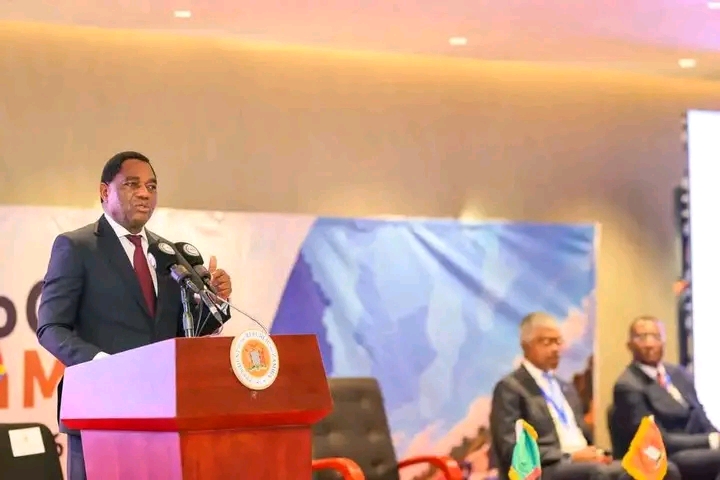
PRESIDENT HICHILEMA CALLS FOR FASTER IMPLEMENTATION OF LOBITO ECONOMIC CORRIDOR
PRESIDENT HICHILEMA CALLS FOR FASTER IMPLEMENTATION OF LOBITO ECONOMIC CORRIDOR
President Hakainde Hichilema has called for accelerated implementation of the Lobito Economic Corridor, urging Zambia, Angola and the Democratic Republic of Congo to move from agreements to tangible economic results.
Officiating at the opening of the Second Lobito Corridor Coordination Meeting at Intercontinental Hotel in Lusaka today, President Hichilema said the Corridor must become a building block for the African Continental Free Trade Area (AfCFTA) by strengthening trade, investment and connectivity.
Here are the key highlights from his remarks;
✅Described the Lobito Economic Corridor as an important building block to Africa’s economic integration and that it should serve as a key building block for the African Continental Free Trade Area (AfCFTA) by promoting trade, investment and connectivity.
✅Suggested that the “engine room” should move beyond meetings and presentations by providing an effective mechanism for coordinating implementation and ensuring that commitments translate into measurable results.
✅Stressed that the Corridor must align with Zambia’s priorities including food security, mining, energy, tourism, job creation and skills development.
✅Further stressed that the Corridor should also create opportunities for Africa’s growing youth population through education, skills development, employment, entrepreneurship and self-employment, noting that economic opportunities are essential for peace, security and stability.
✅Called for particular attention to the Luacano–Chingola section of the Zambian leg, saying it should not be treated as secondary to other components of the corridor.
✅Cited mining investments such as Lumwana, Kansanshi and Kalumbila as potential sources of increased cargo and investment.
✅Urged stakeholders to explore opportunities in copper, nickel and other minerals.
✅Called for the inclusion of the private sector in the “engine room” from the outset to flag regulatory, financial and administrative barriers to investment and joint ventures, citing Zambia’s Public-Private Dialogue Forum as a model.
✅Further called for more efficient border operations, including 24-hour services, adequate shift workers, digital customs procedures, single-window systems, digital payments and integrated immigration processes.
✅Stressed that the corridor should also be supported by feeder roads connecting businesses and communities to the main route and railway, noting that rail transport can lower costs and reduce damage to roads.
✅Encouraged the private sector to be incorporated into the corridor’s implementation and monitoring structures.
✅Proposed a red-flag mechanism to identify delays whether caused by Governments or cooperating partners, including the World Bank Group, AfDB, IFC and EU.
✅Suggested that future reviews should focus on tangible results, especially jobs created adding that the youth must see emerging opportunities and education reforms being aligned to skills needed along the Corridor.
✅Stressed that the Lobito Corridor should remain a business and development platform rather than a political platform, with investment promotion treated as a national agenda in Zambia, Angola and the DRC.
✅Further called for stronger cooperation among the three countries and better coordination among development and financing institutions to ensure that partners complement rather than compete with one another
✅Urged stakeholders not to allow the estimated US$700 million financing gap to limit ambition and encouraged investment in mineral production, maize exports, value addition and new industries.
HK