
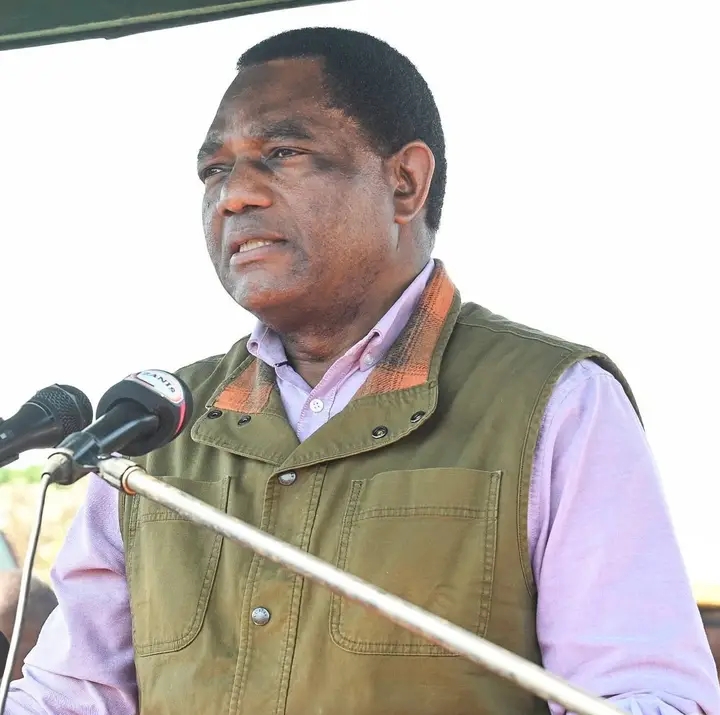
PRESIDENT HICHILEMA’S HYPOCRISY ON CORRUPTION
President Hakainde Hichilema has fashioned an image for himself as a man of integrity fiercely opposed to corruption—a stance that won him significant political support to win 2021 elections.
However, some revelations starkly contrast with this cultivated persona, showing that his conduct diverges profoundly from the values he publicly espouses, prompting others to label him a presidential scam.
At the heart of President Hichilema’s hypocrisy is the controversy from the leaked audio recordings involving key political figures close to him.
In the recent instance, Lasford Mulusa, a former Government Chief Whip and Member of Parliament for Solwezi North and Central, disclosed that President Hichilema assigned him the task of bribing independent candidates in North-Western Province.
The objective is to pressure these candidates to withdraw from elections, thereby ensuring the advantage of United Party for National Development (UPND) Members of Parliament.
Mulusa’s claims reveal a blatant contradiction: a president who publicly condemns corruption yet orchestrates manipulative and unethical political strategies “imingalato” behind closed doors.
Another audio implicates the President in sending Robert Chabinga to South Africa to influence judicial decisions through bribery, as Chabinga revealed.
These disclosures suggest that President Hichilema’s anti-corruption rhetoric is simply a façade designed for political expediency rather than a genuine commitment to reform.
Unfortunately, he fails to realise the weight of these revelations that are never addressed and continues to project an image of a person free from corruption, while citizens can see through his hypocrisy hurting government and the broader battle against corruption.
He adopted a hardline stance against corruption but has failed to set a precedent for transparency and accountability, disappointing many citizens and international partners alike especially the United States that has shown how corrupt his government is.
It is because of being implicated in the very corrupt practices he denounces, that has bred so much cynicism and even hatred against his presidency.
Therefore, his five years in office have been marked by this unsettling duality: an outward image of integrity juxtaposed with behaviors that betray those ideals.
This dissonance makes people to question his fitness to lead the country again and feel scammed; he is not as noble or virtuous as he portrayed himself prior to the 2021 elections.
If the President uses proxies such as Chabinga and Mulusa to conduct corrupt dealings, how many other un-leaked corruption activities or even deals with government has he engaged in using proxies while putting on a false innocent face at the expense of public resources used to bribe people, justice, and ethical governance?
His pattern of hypocrisy is an entrenched lifestyle that stifles the functioning of anti-corruption institutions, which is presumably why, in five years in power, no senior government figure was arrested despite amassing unexplained fortune – most likely they were his proxies.
Ultimately, President Hichilema’s integrity—or lack thereof—is at stake. The electorate’s tolerance of his hypocrisy has left them wary of unmet promises.
As the country prepares for elections in August, President Hichilema’s hypocrisy has prompted many people to decide not to vote for him.
The true test of leadership is integrity, which is more than a campaign slogan and represents a genuine commitment to combating corruption.
By Given Mutinta