ZCCM Wants Back Into London. It Still Can’t File Its Accounts.
Amb. Emmanuel Mwamba Wrote;
Zambia’s state copper investor is selling a comeback. The suspended shares, the boardroom walkout and a corruption score sliding into an election year tell a harder story.
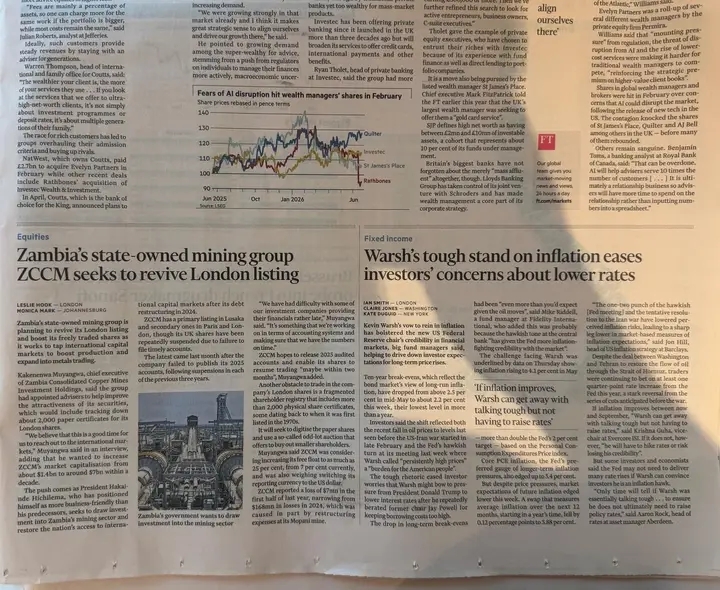
Kakenenwa Muyangwa has a comeback to sell. The chief executive of Zambia Consolidated Copper Mines Investment Holdings told the Financial Times this month that he wants to revive the company’s dormant London listing, free up its sliver of tradable shares, round up the thousands of paper certificates still floating around from the 1970s, and grow ZCCM from a roughly $1.4bn business into a $7bn one within a decade. Copper is the metal everyone wants for the energy transition, Zambia has plenty of it, and President Hakainde Hichilema has spent four years telling the world the country is open for business. On paper, the timing looks shrewd.
It is a clean story, which is also outrunning some inconvenient facts. Start with the one Muyangwa would rather frame gently. ZCCM’s London shares were pulled again on 1 May this year at the company’s own request because it could not get its audited accounts out on time. By now that is a habit. The first London suspension landed in May 2023 over missing 2021 and 2022 figures, and the shares have been knocked off the exchange for the same failure in each of the years since. Management blames its investee companies for reporting late. That is a charitable account of the problem. ZCCM exists to hold stakes in other businesses and tell the market what they are worth; a holding company that cannot manage that four years running is asking investors to buy something it cannot itself describe.
The accounting mess sits on top of a quieter governance story. In 2023 the company’s chair, Dolika Banda, a respected figure in international finance, left abruptly. The widely reported reason was interference from State House. Boardroom exits happen, but a chair walking out over political pressure is a different signal from a chief executive who is merely overstretched, and it goes to the heart of what a ZCCM share actually is.
Because for all the talk of a London listing, this is not an ordinary public company. The state’s Industrial Development Corporation owns 60.3% of it, and the government holds more besides — and the IDC is itself chaired by the president. Hichilema personally sits atop the holding company that controls ZCCM, a concentration the World Bank singled out in a 2024 review as a conflict of interest that invites political interference, recommending he be removed from the board. He has not been. He remains its chairman, and the structure the country’s own lenders flagged for reform is still in place; the government’s answer is that the law makes the president chair — though that law is the government’s to amend. Outside shareholders, meanwhile, own the leftovers, and the worth of those leftovers depends on deals the government decides to do.
The clearest illustration is Mopani itself. When Abu Dhabi’s IRH took control of the mine in 2024 — through a subsidiary, Delta Mining, and a fresh issue of shares — the transaction never went before Parliament. Opposition MPs, lawyers and civil-society groups call that a breach of Article 210 of the constitution, which requires the legislature to sign off on the disposal of major state assets; they add that IRH was never among the bidders the government’s own advisers had shortlisted, and that it put no cash into the treasury, only a pledge to invest. The government flatly rejects all of it. Its attorney-general, Mulilo Kabesha — who chaired the UPND’s lands committee before his appointment — advised that because Mopani issued new shares rather than selling existing ones, no state asset changed hands and Parliament’s approval was not required.
The Constitutional Court was petitioned to nullify the deal, and opposition figures have promised to reverse it if they take power, calling it unconstitutional. The episode is the tell: a billion-dollar handover of one of Zambia’s largest copper operations turns on a contested legal opinion rather than an open vote and a country whose institutions can be routed around that easily is a riskier place to park money than the brochure suggests.
Then there is our country itself. Transparency International’s latest index made for uncomfortable reading: Zambia’s score fell for the first time in five years, from 39 to 37 out of 100, dragging it down to 99th of 182 nations. The watchdog’s Zambian chapter was blunt about why — public money being steered toward business interests and political allies in the run-up to the general election due in August 2026.
That election hangs over everything. Analysts at the Africa Center for Strategic Studies, the Bertelsmann Transformation Index and Zambian commentators such as Sishuwa Sishuwa describe a government growing less tolerant of opposition: rallies blocked, critics arrested, awkward questions about who now sits on the electoral commission. Hichilema waves the criticism away. He insists the 13 August vote will be peaceful and credible, and points to Zambia’s freshly completed IMF programme as proof the reform story is genuine. A reader can hold both pictures in mind at once. But for a state company asking investors to wire in money, an election that could turn ugly – in the very window it hopes to be raising capital – is not the kind of thing you bury in the small print.
The reforms are not a total sham. Lifting the free float from 7% toward 25%, reporting in dollars and untangling a chaotic share register are real, sensible, investor-friendly moves, and Muyangwa deserves credit for pushing them. The catch is that they describe where ZCCM wants to be, not where it is.
What would change the calculation is dull and specific: a few years of clean accounts, filed on time. Until the books close on schedule and the board can show it answers to shareholders rather than the presidency – and until the election, and how minority investors fare after it, stop being open questions – the relisting is a brochure for a place the company has not yet arrived.