
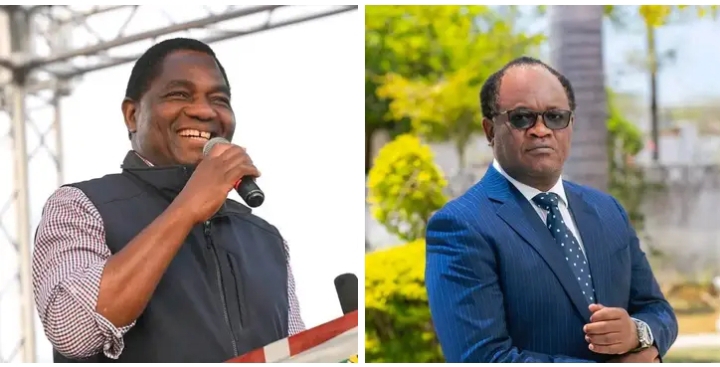
ZAMBIA AFTER THE ELECTION: WHEN POLITICAL RIVALRY BEGINS TO THREATEN NATIONAL UNITY
ZAMBIA AFTER THE ELECTION: WHEN POLITICAL RIVALRY BEGINS TO THREATEN NATIONAL UNITY
✍️. Ethan John Nchenje
Truth Without Fear @TWF
ZAMBIA MUST NOT BECOME ANOTHER COUNTRY’S HISTORY LESSON
Zambia must confront an uncomfortable truth: an election can end at the ballot box, but political hatred does not automatically end when the results are announced. The danger facing the country today is not simply that politicians disagree. Political disagreement is normal in a democracy. The danger is that political competition can gradually become tribal suspicion, social hostility and ultimately a refusal to regard fellow citizens as fellow Zambians
The aftermath of the 13 August 2026 election has already produced serious warning signs. President Hakainde Hichilema was declared the winner with about 60% of the presidential vote, while Brian Mundubile received about 38%. The opposition has questioned aspects of the electoral process and indicated that it intends to challenge the result. At the same time, arrests and a deadly security operation involving opposition figures have intensified the political atmosphere. This is precisely the moment when political leaders should lower the temperature, not pour fuel on the fire. Unfortunately, Zambia is witnessing an increasingly poisonous political environment in which citizens can begin to feel that their ethnic identity determines their political belonging. That is dangerous.
We must stop pretending that tribal politics is merely unpleasant rhetoric. When political arguments repeatedly become arguments about #Bemba, #Tonga, #Chewa, #Lozi, #Ngoni, #Lunda, #Luvale, #Kaonde or any other identity, the country begins moving away from political competition and towards collective suspicion. And once citizens begin judging one another according to the tribe they belong to rather than the ideas they hold, the foundations of a peaceful republic begin to crack. Today it may be insults on social media. Tomorrow it can become discrimination in employment.
Then exclusion from political participation. Then communities begin seeing one another as enemies.
History across Africa demonstrates how quickly political identity can become ethnic identity when irresponsible leaders deliberately exploit grievances. That is why the current atmosphere deserves serious attention rather than political complacency. Zambia should not wait until citizens are afraid of one another before admitting that something has gone terribly wrong. Perhaps the most disturbing development is what happens to people who refuse to belong to either political camp.
A citizen can support the government on one issue and criticise it on another. A citizen can admire the opposition’s courage while rejecting its policies. A citizen can vote differently from his neighbour without becoming an enemy. That is what democracy is supposed to accommodate. But when political camps become increasingly intolerant, neutrality itself can become dangerous. You are asked; Who are you supporting? If you refuse to answer, you are treated as an enemy.
If you criticise the government, you are labelled an opposition sympathiser. If you criticise the opposition, you are accused of being a government propagandist. If you condemn political violence regardless of who commits it, both sides may accuse you of betrayal. This is how democratic societies begin losing their middle ground. And when the middle disappears, extremists acquire the microphone. To the politicians of Zambia: you did not merely contest in the just ended elections, you were influencing the behaviour of millions of people. Every reckless statement from a senior political figure is potentially repeated thousands of times by supporters.
Every accusation of treason, tribal betrayal, electoral theft or national conspiracy can deepen public suspicion. Every attempt to portray an entire community as responsible for the actions of individual politicians is political irresponsibility of the highest order. And every government that treats legitimate political dissent as an existential threat risks transforming ordinary opposition into permanent hostility. Likewise, every opposition leader who portrays every action of the state as evidence of dictatorship risks convincing supporters that democratic institutions are incapable of resolving political disputes.
Both sides must understand this: Zambia is bigger than UPND and NRPUP. Zambia is bigger than the governing party, bigger than the opposition. Zambia is bigger than Hichilema. Zambia is bigger than Mundubile.
No politician is worth the destruction of this country.
It would be irresponsible to claim that Zambia is inevitably heading towards civil war or genocide. There is no basis for presenting such an outcome as predetermined. But it would be equally irresponsible to ignore the warning signs. The 2026 electoral process has already been associated with intimidation, violence and disruption, while international observers and rights officials have raised concerns about aspects of the post-election environment.
That should concern every Zambian. Civil wars do not normally begin with somebody announcing, “Today we are starting a civil war.” They begin with accumulated grievances, They begin with political demonisation, They begin with communities losing trust in one another.
They begin when institutions are no longer trusted to resolve disputes. They begin when political opponents stop being regarded as legitimate competitors and start being treated as existential enemies. And they become especially dangerous when ethnic identity becomes the organising principle of political mobilisation. That is why the present political temperature must come down.
President Hakainde Hichilema now has an enormous responsibility.
Having secured a second mandate, the presidency must become a source of reassurance to all Zambians, including those who did not vote for him. Winning an election gives a government the authority to govern. It does not give it permission to humiliate its opponents. The opposition, equally, has a responsibility to challenge government through constitutional and democratic means rather than rhetoric that can encourage confrontation.
The courts must be trusted to adjudicate electoral disputes.
The Electoral Commission must be transparent. The police must act professionally. The media must resist inflammatory propaganda. And political parties must discipline supporters who cross the line into tribal hatred and violence. We have inherited something precious from previous generations:
#One #Zambia, #One #Nation.
That slogan cannot remain something we repeat at national ceremonies while behaving differently in political life.
A Zambian in Southern Province must not feel threatened because of the political choices of someone in Northern Province. A Zambian in Luapula province or Muchinga must not feel threatened because of the political loyalty of Western province. A person from the Copperbelt must not be treated as responsible for the actions of a politician from the same region. A citizen from Eastern Province must not be stereotyped according to how another citizen from that province voted. Individuals vote. Tribes do not vote. And political parties are not ethnic communities. That distinction must become sacred.
The Author is a Realist Pan-Africanist
An advocate for good governance and national transformation.
He is passionate about the Reign of Christ, justice and the future Africa and he is the President of High commissioners