
Public Office, Private Paymaster: The Foreign-Funded Adviser Inside Hichilema’s State House
This is what specialists mean by state capture: not a single bribe, but the slow migration of public functions into private hands, until it is no longer clear where the government ends and outsid
Somewhere on the org chart of Zambia’s State House sits a policy adviser to the president who, according to a new Global Witness investigation, was paid not by the Zambian taxpayer but by a private foreign foundation.
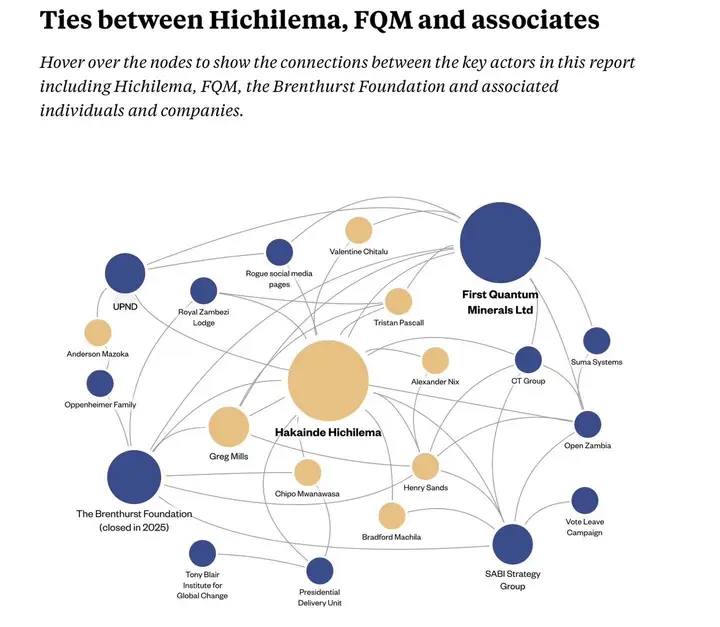
Her name is Chipokota Mwanawasa, and the arrangement the report describes of a public official on a private payroll lies at the centre of a tangle of relationships that many of us have long warned edges toward state capture.
Mwanawasa is the Policy Advisor to President Hakainde Hichilema and served as deputy head of the Presidential Delivery Unit, the body set up to drive the government’s flagship projects. Her public biographies list degrees from the London School of Economics and Cape Town, a Chevening scholarship and a fellowship from Ellen Johnson Sirleaf’s leadership centre. They also record a long association with the Brenthurst Foundation, the Oppenheimer-funded think tank run by Greg Mills, with whom she co-authored papers on African democracy, and note that before government she worked as a legal officer at one of Africa’s largest copper mines.
It is that Brenthurst link that Global Witness places at the heart of its concern. Citing multiple sources, including a former Brenthurst employee, the report says the foundation paid the salary of Mwanawasa’s newly created State House role, leaving her a policy adviser to the president, but on a private foundation’s payroll. The effect, a former Brenthurst staffer told the group, was to turn her into a “nexus,” a channel that gave Mills himself deeper access to the presidency. Global Witness alleges no crime, and stresses that it found no breach of Zambian law.
Set out plainly, the overlap is striking. Brenthurst, a South African foundation bankrolled by a mining dynasty, is said to have paid a salary inside the Zambian presidency. The presidency’s delivery unit, where Mwanawasa served as deputy head, receives technical support from the Tony Blair Institute, the London-based body founded by the former British prime minister. And the same unit, sources told Global Witness, has been working on Hichilema’s 2026 re-election campaign. Threaded through all of it is First Quantum Minerals, the Canadian copper giant whose interests, the report argues, the Mills–Brenthurst policy advice consistently served.
Four outside entities, in other words, a British institute, a South African foundation, a Canadian miner and their shared personnel, appear at various points to overlap with the machinery of the Zambian state: its policy advice, its delivery unit and, if the report’s sources are right, its 2026 reelection campaign.
This is what specialists mean by state capture: not a single bribe, but the slow migration of public functions into private hands, until it is no longer clear where the government ends and outside interests begin.
When a delivery unit built to serve citizens is also reported to be working on a campaign, and when the adviser who helped run it drew her pay from a foreign foundation than the treasury, the ordinary lines of accountability blur. To whom does such an official answer? The public that her office serves, or the paymaster that funds her salary?
Mills has dismissed the Global Witness report as a conspiracy theory built on falsehoods. The Zambian government “pre-bunked” it as false and irresponsible even before its official release.
The Tony Blair Institute says it does not fund the Presidential Delivery Unit and plays no part in the election. First Quantum denies bankrolling any campaign.The objection is not that expertise came from outside but it is that a foreign paymaster inside the presidency was never disclosed to the Zambians it affects.
That is the crux. A single salary is a small thing beside a $771 million tax break or a $50 million campaign pledge which are the sums that dominate the Global Witness report. But it is a telling detail in it, because it shows how quietly the lines can be crossed. It is a question about who the government is really working for and, in an election year, one all Zambians are entitled to see answered before they vote.