
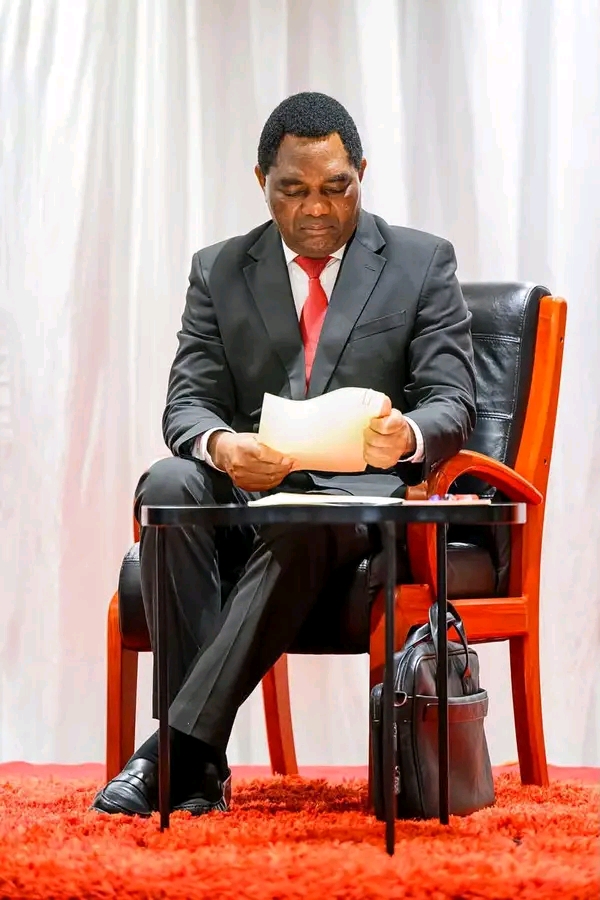
LEST WE FORGET: WHAT HAS CHANGED UNDER HAKAINDE HICHILEMA 🇿🇲
🛑LEST WE FORGET: WHAT HAS CHANGED UNDER HAKAINDE HICHILEMA 🇿🇲
If we are going to discuss President Hakainde Hichilema’s record honestly, we should separate what has already been delivered from what is now being promised for the next five years.
I am not claiming that everything is perfect. Cost of living, jobs, debt risks, electricity and other problems remain. But there is also a record that should not be forgotten.
🇿🇲 1. FREE EDUCATION
Free education was reintroduced in 2021. According to the 2026 State of the Nation report, more than 2.5 million children returned to school as a result of the policy.
Government has also recruited 41,917 teachers, with another 2,000 planned for 2026.
The policy has now also been backed by legislation, making free schooling a legal entitlement. More children are in school, parents no longer have to pay basic school fees, and thousands of teachers have been added.
🏫 2. MORE CLASSROOMS AND SCHOOL FEEDING
Thousands of classrooms have been constructed through government programmes, including CDF. The school feeding programme expanded from 1.5 million learners in 2021 to 4.7 million in 2025.
💰 3. CDF HAS CHANGED SIGNIFICANTLY
The Constituency Development Fund increased from K1.6 million per constituency to K40 million in 2026.
That money has been used for things like:
classrooms
health posts
boreholes
police posts
ambulances
skills training
youth and women empowerment
community projects
boarding-school sponsorships.
This is one of the most visible changes because development money is reaching constituencies directly.
👩🏾⚕️ 4. HEALTH WORKERS HAVE INCREASED
Government reports that more than 18,000 health workers have been recruited since 2021, with another 2,000 planned in 2026. It also reports 282 new health facilities constructed.
Medicine availability has also improved substantially from the levels reported in 2021.
👵🏾 5. SOCIAL CASH TRANSFER HAS EXPANDED
The Social Cash Transfer programme has expanded to 1.5 million households.
K800 every two months = K400 per month
K1,200 every two months = K600 per month for households with a person with a disability.
For poor households, even a relatively small increase has made a difference.
💼 6. PENSION REFORMS
One of the major changes was allowing members of NAPSA to access 20% of their pension savings. By January 2026, 518,183 members had accessed the partial withdrawal, amounting to about K10.6 billion. The government also enacted new pension legislation in 2026.
⚡ 7. ELECTRICITY: FROM CRISIS TO INVESTMENT
This is probably one of the biggest stories of the first term.
We went through severe electricity shortages, particularly after the drought affected hydropower generation. Government has since expanded generation capacity.
According to the Ministry of Energy, installed generation capacity increased from 3,100MW in 2021 to 4,576MW in 2026. Solar increased from 88MW to 841MW.
The 750MW Kafue Gorge Lower project was also fully commissioned.
And Zambia has introduced reforms such as:
electricity open access
net metering
a single licensing system
the Integrated Resource Plan.
The World Bank also says Zambia’s electricity situation is moving from being a major constraint toward becoming a potential driver of growth, although major challenges remain.
💵 8. DEBT RESTRUCTURING
This is perhaps the least visible achievement to an ordinary person but one of the most important economically.
Zambia entered office in 2021 with a major debt crisis and had defaulted on its external debt. The government subsequently negotiated debt restructuring with creditors.
The World Bank reports that Zambia’s public debt fell from 133.4% of GDP in 2023 to an estimated 93.4% in 2025, with restructuring agreements covering about 94% of external debt.
The African Development Bank described the restructuring agreement as putting Zambia back on a path toward sustainable debt management.
📉 9. MACROECONOMIC STABILISATION
Government reported average growth of about 5.2% between 2021 and 2024, compared with 1.5% between 2017 and 2020.
The IMF projected 5.8% growth for 2026, supported by recovery in electricity, mining and services.
The World Bank says Zambia recorded 7.7% year-on-year growth in Q1 2026, driven largely by agriculture, improved electricity supply and other factors.
🌽 10. AGRICULTURE AND FOOD PRODUCTION
The 2025/26 agricultural season produced a record maize harvest of almost 5 million tonnes, according to the World Bank.
The government has also expanded support to vulnerable farmers through the Food Security Pack programme. In 2026, the programme reached 320,000 beneficiaries, up from 240,000.
The bigger question now is whether Zambia can move from simply producing more maize to becoming a major agro processing and food export economy.
⛏️ 11. MINING IS BEING REVIVED
Government has worked on the revival and restructuring of Mopani and KCM, alongside other mining investments.
The stated ambition is now much bigger: Zambia wants to increase copper production dramatically. The administration’s new target is 3 million tonnes of copper per year.
The challenge is not simply producing copper. It is ensuring that Zambians benefit from the mines through jobs, suppliers, local businesses, taxes and value addition.
🛣️ 12. ROADS AND INFRASTRUCTURE
There has been significant road construction and rehabilitation.
Examples include:
Lusaka–Ndola Dual Carriageway
Chingola–Chililabombwe–Kasumbalesa
Kafue Bridge
Mongu–Limulunga
various provincial and district roads.
Government also continued projects that had stalled. The point is not that every road has been fixed. It hasn’t. But there has been substantial infrastructure activity during the period.
🚰 13. WATER AND SANITATION
Government reported that more than 4.9 million people had gained access to clean and safe water through various interventions.
CDF has also financed water projects across constituencies.
👩🏾 14. SUPPORT FOR GIRLS
The Keeping Girls in School programme expanded significantly. In 2025, 127,233 girls benefited, compared with 38,551 in 2021. Support for menstrual hygiene also expanded to more than 1.7 million girls.
👷🏾 15. CASH-FOR-WORK
Following the devastating 2023/24 drought, government expanded Cash for Work as a way of putting money into affected communities. By 2026, the programme had been expanded across all 116 districts.
🏛️ 16. CORRUPTION AND ASSET RECOVERY
The administration made the recovery of suspected proceeds of corruption a major part of its governance agenda.
The 2026 State of the Nation report described the asset recovery programme as the largest ever undertaken in Zambia. Government also reported that corruption and economic crime cases could now be prosecuted much faster than previously.
🌍 17. TOURISM
Tourism has also grown.
Government has reported international tourist arrivals increasing from roughly 500,000 to more than 2 million.
The next ambition is much bigger.
Under Grow Zambia, Zambia wants 5 million tourist arrivals every year.
🇿🇲 AND NOW: THE GROW ZAMBIA AGENDA 🇿🇲
Grow Zambia is not an achievement yet.
It is the second-term development programme and set of targets announced by Hichilema after his September 2026 inauguration.
The idea is to move Zambia from economic stabilisation to accelerated growth.
The targets are:
10 – 10 – 5 – 3 – 3 – 1 – 1 – 1
🌽 10 million tonnes of maize, By 2031.
⚡ 10,000MW of electricity
To provide enough power for households, mines, farms and industry.
🦒 5 million tourists, Every year.
⛏️ 3 million tonnes of copper, Every year.
🌱 3 million tonnes of soya, Every year.
🌾 1 million tonnes of wheat, Every year.
🍬 1 million tonnes of sugar, Every year.
🥩 US$1 billion beef exports
Aiming to build a major beef-export industry.
These are targets, not results.
THE BIGGER IDEA,🇿🇲
The first term can broadly be described as:
Stabilise the country.
The second term is being presented as:
Grow the country.
That means the conversation is supposed to move from:
Debt → investment
Electricity shortages → energy production
Raw copper → more copper production and value chains
Small-scale farming → commercial agriculture and exports
Government jobs → private-sector jobs
Dependence → production
Stabilisation → growth
That is the logic behind Grow Zambia
LEST WE FORGET..
These achievements do not mean every problem has been solved.
The real test of Grow Zambia will be whether these numbers eventually become jobs, businesses, cheaper and reliable electricity, higher incomes, stronger local companies and better living standards for ordinary Zambians. For now, WE WORK TOGETHER TO MAKE THIS A REALITY.
Mukuli,🇿🇲