
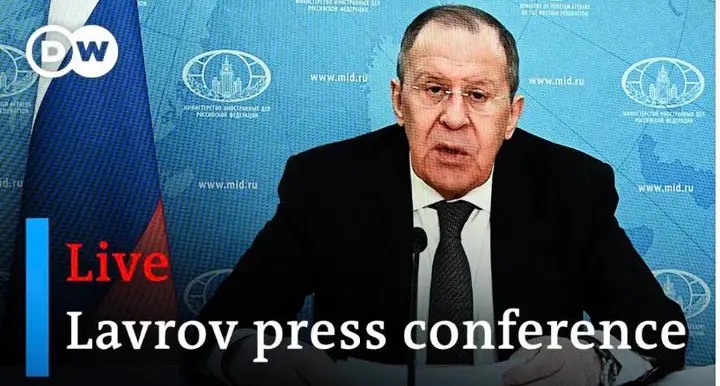
Lavrov says he’d welcome Ukraine into the EU — because it would make the bloc “fall apart.”
Lavrov says he’d welcome Ukraine into the EU — because it would make the bloc “fall apart.”
He said the same thing about sanctions unity in 2014. And about energy shock unity in 2022. Both times he was wrong — and both times he was hoping to be right.
The “concern” isn’t concern. It’s a bet against European cohesion, placed by the one government with the clearest interest in that bet paying off. Full breakdown below 👇
Lavrov’s Concern Trolling
Sergey Lavrov wants you to believe he is worried about the European Union. Ukraine’s accession, he told reporters this month, might “not be a bad idea” — because it would cause the bloc to “simply fall apart.” The internal contradictions, he explained, are already there. Ukraine would just be the thing that finally exposes them.
It is a good line. It is also nonsense, and worth taking apart quickly, because lines like this travel fast and get treated as analysis when they are, in fact, wish-casting dressed up as diplomacy.
Notice what he is not saying. Lavrov is not arguing Ukraine is unfit for membership, or that the acquis is too demanding, or that the economics don’t work. Those would be substantive objections, the kind Brussels itself debates constantly. Instead he has skipped straight to prophecy: admit Ukraine, and the whole architecture collapses. This is not a critique of Ukraine. It is a bet against Europe’s capacity to hold itself together, offered by the one actor on earth with the clearest interest in that bet paying off.
We have heard this before. In 2014, after Crimea, the consensus in Moscow was that European unity on sanctions would crack within a season — that German industry, Italian energy dependence, and French Gaullist instincts would pull the coalition apart before it ever hardened. It didn’t. In 2022, the prediction was repeated with more confidence: an energy shock over one winter would fracture the EU faster than any enlargement debate ever could. It didn’t do that either. The bloc that was supposed to fragment instead opened accession talks with Ukraine within months of the invasion — talks that reached their first negotiating cluster this June. Lavrov’s timing is not incidental. He is reaching for the collapse thesis again at the exact moment the process he predicted would never happen keeps happening.
The tell is the framing itself. A foreign ministry that genuinely believed EU accession would fracture the Union from within would have no reason to say so out loud — you let your adversary walk into the trap. Announcing the trap, cheerfully, in front of cameras, is not analysis. It is an attempt to plant doubt in exactly the member states — Slovakia, Hungary, others with domestic reasons to hesitate — whose hesitation Moscow has spent years cultivating by other means. The “concern” is instrumental. It is a rhetorical device aimed at the audience most inclined to find EU enlargement fatiguing, delivered by the government least entitled to an opinion on European institutional health.
And there is a harder fact sitting underneath the soundbite. Lavrov delivered this line as part of a broader argument that Europe is abandoning economics for militarization against Russia — the same press conference gestured at British-led maritime cooperation with Kyiv as further evidence of European bad faith. It is worth sitting with the sequencing: a government whose forces struck Kyiv again on July 2 is, in the same fortnight, positioning itself as the party solicitous of the EU’s long-term institutional coherence. That is not concern. That is a foreign minister trying to have it both ways — waging a war that is actively reshaping European security policy, while claiming detached, almost philosophical interest in whether Brussels can hold its own union together.
It probably can. It has, twice already, when Moscow said it couldn’t.