
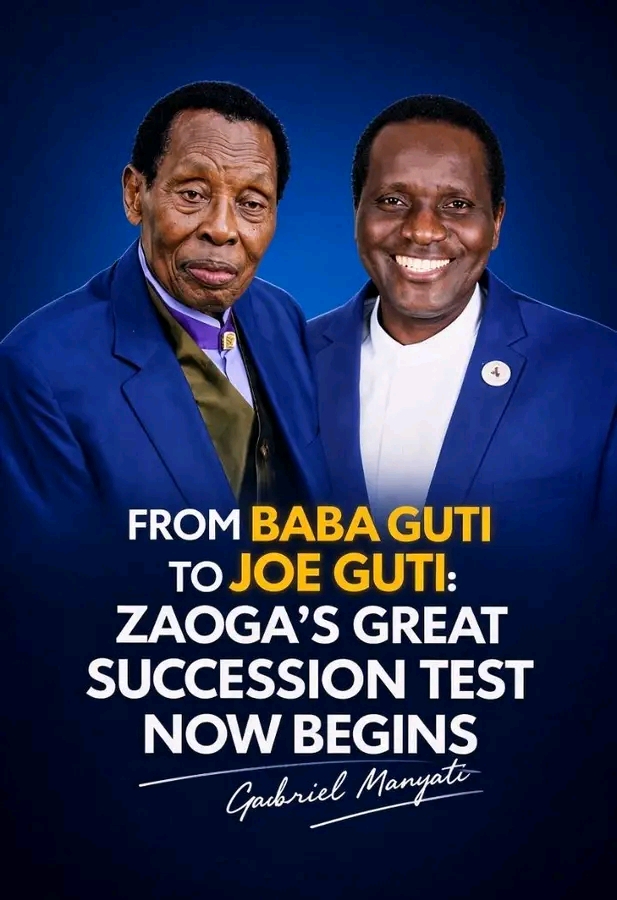
FROM BABA GUTI TO JOE GUTI: ZAOGA’S GREAT SUCCESSION TEST NOW BEGINS
FROM BABA GUTI TO JOE GUTI: ZAOGA’S GREAT SUCCESSION TEST NOW BEGINS
By Gabriel Manyati
On Sunday, 20 September 2026, Glamis Arena in Harare became something more than a venue for a church service. It became a theatre of succession.
Thousands of ZAOGA Forward in Faith International worshippers filled the stadium for the Legacy National Big Sunday, gathering to honour the late Archbishop Professor Ezekiel Handinawangu Guti and to formally welcome Archbishop Dr Joseph “Joe” Guti as the church’s leader. On the platform was the uncomfortable visual truth confronting one of Zimbabwe’s most remarkable Pentecostal movements: the man whose presence had dominated ZAOGA for more than six decades was no longer there. Someone else now had to stand where he once stood.
That is why the Glamis gathering matters.
This was not simply another big Sunday, another anniversary or another celebration of a revered preacher. It was a public demonstration that a movement built around the authority, personality, teaching and spiritual legacy of one extraordinary founder must now persuade its followers that the institution can remain compelling under another leader.
The question hanging over the stadium was therefore larger than Joseph Guti himself.
What happens to a religious movement when the founder is gone but the institution he built is expected to remain?
The Man Behind The Institution
To understand the weight now resting on Joseph Guti, one has to understand the scale of what Ezekiel Guti built.
According to ZAOGA’s own institutional history, Guti arrived in Bindura in 1960 and, on 12 May that year, the movement that became ZAOGA was born under a gum tree. What began as a small indigenous Pentecostal ministry eventually became ZAOGA in Zimbabwe and Zambia and Forward in Faith Ministries International internationally.
Guti died on 5 July 2023 at the age of 100 after 75 years of ministry. By then, the organisation associated with his name was no longer simply a collection of congregations. It had become an international network of churches, pastors, Bible schools, educational institutions, social initiatives, conference centres and economic empowerment programmes.
FIFMI says it is now present in more than 160 nations and states. Its own account of Guti’s ministry says he trained more than 10 000 pastors who went on to serve within FIFMI and other ministries around the world.
Those figures need to be understood institutionally rather than as marketing slogans. A movement operating across more than 160 nations and states requires pastors, administrators, buildings, training systems, finance, communications, schools, leadership conferences and mechanisms for transmitting doctrine across borders.
The founder’s legacy is therefore not preserved merely in sermons recorded on video. It is embedded in structures.
Take the Africa Multination for Christ College in Harare. Established on 6 July 1977, the institution says it has trained more than 5 000 pastors from countries including Britain, the United States, Australia, New Zealand, Zambia, Malawi, Mozambique, South Africa, Ghana, the Democratic Republic of Congo, Namibia and others.
Then there is Zimbabwe Ezekiel Guti University in Bindura, which opened its doors in 2012. It now has faculties covering areas including commerce, education, law, agriculture and religious studies, with an explicit emphasis on entrepreneurial development.
The founder’s influence also reached into economic empowerment. Academic research on ZAOGA’s Talents programme documents how church members were encouraged to develop businesses, acquire assets and pursue self-reliance rather than simply wait for miraculous intervention. The programme helped finance institutional projects, including AMFCC and ZEGU.
This is the inheritance Joseph Guti has received.
It is considerably larger than a pulpit.
The Successor Steps Into The Frame
Joseph Guti is not an outsider parachuted into an unfamiliar organisation.
He is Ezekiel Guti’s grandson and had already held important responsibilities inside the movement before becoming its principal leader. ZAOGA says he served as a founding acting vice-chancellor of ZEGU, was declared “father of the church” by Ezekiel Guti and worked with his wife, Nyasha Miriam Guti, in ministry and pastoral training. He was consecrated Archbishop on 25 January 2026.
His formal rise unfolded gradually after the founder’s death.
In July 2023, Joseph Guti was announced as the new president of the ministry. In September 2024, he was ordained Presiding Bishop. In January 2026, he was consecrated Archbishop.
That chronology matters because Sunday’s gathering at Glamis was not the beginning of the succession. It was the public consolidation of a transition that had been unfolding for three years.
And this is where Joseph Guti’s remarks become revealing.
At Glamis, he said ZAOGA members should pray for government leaders rather than merely criticise them. He described Christians as “the salt of the nation”. He also insisted that the church was not worshipping Ezekiel Guti.
“Baba Guti used to say he was just a messenger of God,” Joseph said. “We did not worship him and will never worship Baba Guti. He gave us Jesus; he pointed us to Jesus of Nazareth.”
That was more than theological housekeeping.
It was succession language.
The Problem With Becoming Baba Guti 2.0
Joseph Guti’s most important challenge may be contained in his own declaration that there is “nothing new to invent or originate” and that the task is to continue the legacy.
Continuity is understandable. In fact, for an organisation of ZAOGA’s size, reckless disruption would be irresponsible.
But continuity has a danger of its own.
Joseph Guti cannot become Ezekiel Guti 2.0.
A successor who spends his entire tenure trying to reproduce the founder’s mannerisms, vocabulary and authority will remain permanently trapped in comparison with the founder. Every sermon becomes a test of whether he sounds sufficiently like Baba Guti. Every institutional decision becomes a referendum on what Baba Guti would have done.
Yet the opposite extreme is equally dangerous.
If Joseph Guti changes too much, too quickly, he risks unsettling members whose understanding of ZAOGA is deeply tied to Ezekiel Guti’s teachings, patterns and landmarks.
That is the central succession dilemma.
The new leader must preserve enough of the old ZAOGA to reassure its members that the church remains recognisably ZAOGA, while changing enough to demonstrate that the movement has a living leadership rather than a permanent maintenance or memorial committee.
The church itself appears to understand this tension. Its international website carries the slogan “The Legacy Continues”, while Joseph Guti simultaneously emphasises that Ezekiel Guti was a messenger who pointed believers towards Christ.
The paradox is fascinating.
The institution is deliberately keeping the founder’s name everywhere while publicly insisting that the founder is not the object of worship.
The challenge is to make those two realities coexist without allowing memory to become immobility.
The Family Question Without The Easy Accusation
The Guti family is inevitably central to this transition. Senior Archbishop Eunor Guti, the founder’s widow, publicly endorsed Joseph’s leadership at Glamis, saying he was the right person to take the church forward and should be supported.
Her position matters because Eunor is not merely a relative of the founder. She has been a major figure in ZAOGA’s development for decades and remains a Senior Archbishop and an influential institutional presence. The church itself describes its current leadership as operating under her advisory support.
There is no need to reduce this to the simplistic language of dynasty or nepotism. The evidence is more complicated.
Joseph was already deeply involved in the organisation. His appointment was endorsed through ZAOGA’s institutional structures, and the church has presented his leadership as a continuation of arrangements made before Ezekiel Guti’s death.
But the harder institutional question remains.
How does a movement distinguish legitimate spiritual succession from hereditary symbolism?
That question will not be answered by a ceremony. It will be answered over years by performance, governance, preaching, leadership development and the willingness of people who knew Ezekiel Guti personally to accept Joseph Guti as a leader in his own right.
A Church And The State
Joseph’s call at Glamis for Christians to pray for government also deserves attention.
ZAOGA does not operate in a political vacuum. Ezekiel Guti’s relationship with Zimbabwe’s political establishment was highly visible. President Emmerson Mnangagwa attended Guti’s centenary celebrations in May 2023. After the founder’s death, the government declared him a national hero, with Mnangagwa praising his contribution to Zimbabwean society.
At the 2023 national hero send-off, Mnangagwa described Guti as a voice of reason, advocate of justice and champion of peace.
Against that history, Joseph’s instruction to ZAOGA members to pray for government rather than merely criticise it is significant. But it should not automatically be interpreted as political submission. Nor should it automatically be interpreted as prophetic confrontation.
The real question is what kind of public voice Joseph Guti will build for a church whose membership stretches across multiple political systems and countries.
A movement spanning more than 160 nations cannot approach politics everywhere in precisely the same way. A congregation in Zimbabwe lives under different political circumstances from one in Britain, Canada, Australia or the United States.
The test will therefore be whether ZAOGA can develop a mature public theology in which praying for rulers does not eliminate the responsibility to speak about justice, corruption, poverty, violence, education, unemployment and the dignity of ordinary citizens.
That remains an open question.
The Generational Test
There is another problem that cannot be solved by preserving old sermons.
The people Joseph Guti is leading are not the same social generation that followed Ezekiel Guti in the 1960s, 1970s and 1980s.
A young ZAOGA member in Harare in 2026 carries a smartphone, watches preachers from Lagos, Johannesburg, London and Dallas on social media, navigates unemployment or entrepreneurship, encounters Pentecostal Christianity through YouTube and TikTok, and may have family members living in several countries.
ZAOGA itself is responding to this environment. In March 2026, its international girls’ leadership seminar brought together more than 1500 participants, while a student leadership seminar later that month involved about 350 student leaders from 23 Zimbabwean colleges and international delegates. The programme included discussion of entrepreneurship, finances and responsible social-media use.
That is the terrain of Joseph Guti’s ZAOGA.
It is not enough to tell younger believers that Baba Guti was great. They need to understand why the movement he built remains relevant to the problems they face.
The same applies to international expansion. In 2026, FIFMI is holding conferences across South Africa, Canada, the United Kingdom, Namibia and the United States, demonstrating that the post-Ezekiel organisation is continuing to operate as a transnational institution rather than a Zimbabwean church with overseas branches.
The question is whether Joseph can make that international network more institutionally integrated without diluting its identity.
The Founder Can Become A Foundation
There is an intriguing possibility hidden inside all this. The death of a founder can weaken an institution because the person who embodied its authority is gone.
But it can also force the institution to mature.
Ezekiel Guti could personally embody the church’s history, doctrine, vision and authority. Joseph Guti cannot do that simply by occupying his grandfather’s chair.
He will have to build systems.
He will have to develop younger leaders who can eventually lead congregations, provinces, countries and institutions without depending entirely on one personality. He will have to demonstrate that ZEGU, AMFCC, the schools, churches and international structures can function effectively because their systems work, not simply because Baba Guti’s name remains above the door.
That is why the most important tests of Joseph Guti’s leadership will be measurable.
Will ZAOGA retain doctrinal stability?
Will its international network continue expanding?
Will its educational institutions grow in quality and relevance?
Will younger leaders emerge?
Will its governance become stronger and more transparent?
Will its economic empowerment programmes adapt to an economy dominated by technology, migration and informal enterprise?
Will its social contribution remain visible?
And perhaps most importantly, can the organisation preserve its identity without becoming trapped in nostalgia?
There is not yet enough evidence to answer all those questions. That is precisely why the succession test has only now begun.
After The Stadium Empties
The most striking thing about Glamis Arena on Sunday was the sheer power of continuity.
Thousands came to honour the man who built the movement. They listened to the grandson who now occupies its highest leadership position. Eunor Guti stood nearby as an unmistakable bridge between the founder’s generation and the one now taking responsibility for the future. The church proclaimed that the legacy continues.
But stadiums can prove enthusiasm. They cannot prove institutional durability.
The real test begins when the crowds go home.
It will be seen in the ordinary ZAOGA congregation meeting next Sunday. It will be seen in the Bible school classroom in Harare, the lecture theatre at ZEGU in Bindura and the pastoral training system that has already produced thousands of ministers. It will be seen in congregations outside Zimbabwe and among young believers who never heard Ezekiel Guti preach in person.
It will be seen in how Joseph Guti handles disagreement, develops leaders, manages institutions, speaks to government, responds to social change and interprets a legacy that is simultaneously his inheritance and his burden.
Ezekiel Guti spent decades proving that the small gathering under a gum tree could become a worldwide movement. Joseph Guti now faces the reverse challenge. He must prove that the worldwide movement can remain alive without the man who first gave it its extraordinary human face.
The easiest part of succession is inheriting the microphone.
The difficult part is proving that the institution can still speak and function with authority after the founder has left the stage.
#ZAOGA
#JosephGuti
#EzekielGuti
#ForwardInFaith
#ZimbabweChristianity