CAN YOU FILE NOMINATION PAPERS AS AN INDEPENDENT CANDIDATE WHILE STILL BELONGING TO A POLITICAL PARTY
Picture this:
A politician storms out of his political party after losing the adoption race.
The very next morning, he calls a press conference.
“I am now an independent candidate!” he proudly announces.
A journalist raises a hand.
“Congratulations, Honourable. Just one small question… have you actually resigned from your party yet?”
The politician coughs, adjusts the microphone and replies, “Not yet… but I’m planning to.”
The room erupts in laughter.
Another journalist chips in, “So, are you an independent candidate… or just an independent thinker?”
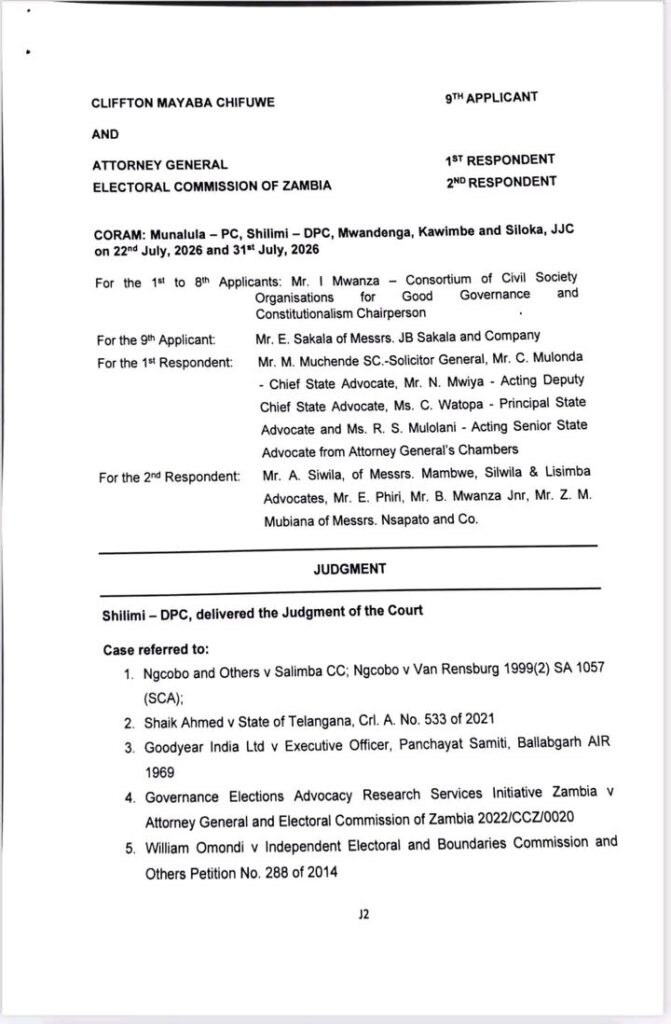
Funny as it sounds, that was the very question the Constitutional Court had to answer.
Some people argued that if you want to stand as an independent Member of Parliament, you must already have resigned from your political party before filing your nomination papers. Others argued that the Constitution says something different: what matters is that you are no longer a party member at least two months before election day.
The Court opened the Constitution instead of a dictionary of political slogans.
It found that the Constitution speaks about the election date, not the nomination date. More importantly, Parliament had previously been asked to change the Constitution so that anyone wishing to stand as an independent would have to resign before filing nominations. Parliament rejected that proposal.
For the Court, that settled the matter. Judges are not editors of the Constitution. They interpret it, they do not rewrite it.
The Court therefore held that a person may file nomination papers as an independent candidate even if they are still a member of a political party, provided they leave that party in time to satisfy the constitutional requirement of having been out of it for at least two months before election day. If they fail to meet that constitutional deadline, their election can later be challenged through an election petition.
What does this mean for ordinary Zambians?
It means not everyone who falls out with a political party automatically becomes an independent candidate. Announcing, “I’ve gone independent!” at a press briefing or on Facebook is one thing; meeting the Constitution’s requirements is another. Whether you qualify depends not on political slogans or dramatic resignations, but on complying with the constitutional timeline. Miss that deadline, and your election can be challenged.
The moral of the story?
Politics can change overnight, but constitutional qualifications do not. You don’t become an independent candidate simply because you say so you become one because you satisfy the Constitution. In the end, it is the Constitution, not the microphone at a press conference, that has the final word.
Disclaimer:
My commentary on this decision is no more a legal critique than a campfire tale is a treatise on thermodynamics. It is, rather, a dramatized retelling, a lively reenactment if you will, of the judicial clash, unburdened by the solemn drudgery of analysis and delivered with the unapologetic zest of a storyteller who knows a good duel when he sees one.