
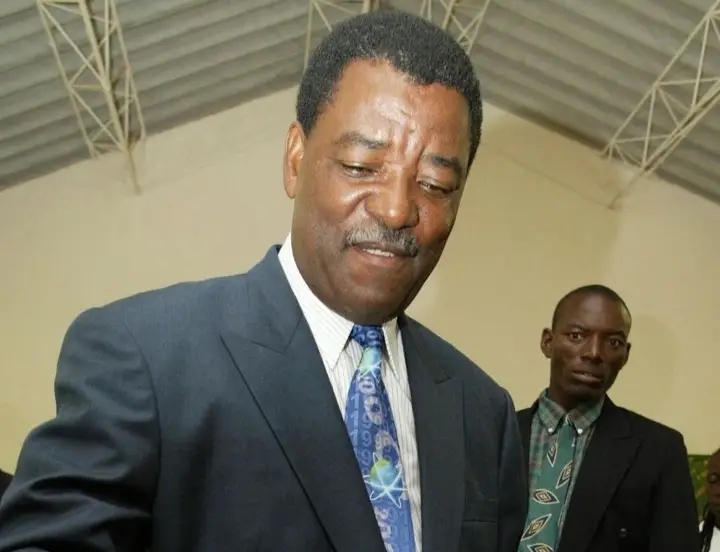
ANDERSON MAZOKA SUCCESSFULLY DISENGAGED FROM SATANISM
By Given Mutinta
ANDERSON MAZOKA SUCCESSFULLY DISENGAGED FROM SATANISM
The political landscape of Zambia has, at various times, been punctuated by deeply personal narratives that resonate beyond the usual discourse of policy and governance.
Among these, the story of Anderson Mazoka, the founding president of the United Party for National Development (UPND).
For many years, Mazoka navigated the political arena under the shadow of persistent rumours linking him to Freemasonry.
In Zambia, a society where religious faith is a significant cultural and political force, and where certain fraternal organizations are viewed with suspicion, the allegations against Mazoka carried considerable weight.
Aiming to lead the nation, Mazoka found himself repeatedly compelled to address the Satanism whispers.
His public denials were consistent and firm, disassociating himself from any organization perceived as being outside the mainstream of accepted religious and societal norms.
This prolonged denial was not merely a personal matter; it was a strategic political manoeuvre, an attempt to pre-emptively counter any potential damage to his reputation and to the UPND’s image.
The carefully constructed narrative of a devout individual, untainted by what were considered “underworld” or “Satanic” affiliations, was crucial for securing popular support in a politically sensitive environment.
The core of this compelling narrative lies in a purported offer made to Mazoka.
As the 2001 elections loomed, with hopes high for a UPND victory, Mazoka was allegedly talked to by underworld masters.
The proposition was stark: guaranteed success in the elections, a prize eagerly sought by any political contender.
However, this electoral triumph came with a steep and chilling condition. The underworld masters demanded control over the “soul” of his government, which translated to the surrender of all executive powers should Mazoka ascend to the presidency.
This meant that instead of wielding authority directly, Mazoka would become a figurehead, receiving all directives on governing from this clandestine entity.
The implications were profound: the executive sovereignty of Zambia would be ceded to an unseen and malevolent, force.
The insidious nature of this proposed arrangement extended to the very fabric of government appointments.
According to the narrative, any individual considered for a ministerial position, deputy minister role, permanent secretary, or senior civil servant would first be discreetly approached.
Their willingness to work with a UPND government would be ascertained. If they assented, they would then be presented with the “condition of joining the freemasonry fraternity.” Acceptance of this condition would initiate a “Satanic induction process” that would precede their formal government appointment.
This would entail swearing an oath of allegiance not to the Constitution of Zambia, but to these underworld masters.
This detailed articulation of the covenant paints a picture of a government not of the people, by the people, and for the people, but one beholden to dark forces.
The crucial turning point in this account is Mazoka’s alleged reaction to the proposed covenant.
The narrative is that Mazoka found the demand to be “too far fetched.”
The implication is that while the allure of power and electoral victory was strong, the price—the compromise of integrity, the surrender of national sovereignty to ungodly powers, and the corruption of the administrative machinery of state—was simply too high a moral and spiritual cost.
He refused to accept the offer, therefore, presenting as a sort of a testament to his character and his ethical boundaries.
The narrative links this refusal directly to the electoral outcome, asserting that the election was “stolen from him” as a consequence of his defiance.
This suggests a belief that forces outside the conventional electoral process, angered by his refusal, conspired to deny him victory.
After losing the elections, his enduring public affection presented a unique challenge to his competitors, leading to the implementation of a gradual, insidious strategy of elimination rather than a direct, overt confrontation.
This became one of Mazoka’s watershed moments in his personal and public narrative, along with his decision to be baptised into the Catholic Church, which stood by his side when he was ill.
This act of religious commitment was not just a spiritual milestone; it was also a moment that again brought his past underworld associations into sharper public focus.
Following his decision to be baptised, Mazoka made a public confession, admitting that he had indeed been a Freemason.
This confession, coming after years of denial, sent ripples through the political and social fabric.
It revealed a man grappling with his past, seeking spiritual reconciliation, and perhaps, as a consequence, deciding to be more transparent with the public he aspired to lead.
The confession highlighted the personal journey he had undertaken, from being an elder in the Seventh-day Adventist (SDA) church while simultaneously being involved in Freemasonry, to his eventual embrace of Catholicism.
This complex layering of religious affiliations and secret society membership presented a stark contrast to the image he had meticulously cultivated.
His baptism into the Catholic Church was preceded by the Church’s spiritual rite designed to free people from evil.
The rite included discernment, which is essential in identifying underworld influences during intense spiritual interviews with a clergyman.
This was followed by prayer and fasting in preparation for the liberation rite.
The actual rite included commanding Satan to leave in Christ’s name, and Mazoka was set free from Satanism.
He received ongoing spiritual guidance to help him recover and maintain his spiritual health, understanding that spiritual warfare is frequently a long-term battle that necessitates constant commitment and divine intervention.
When Mazoka died, he was fully healed and spiritually restored in Christ Jesus, back to God and to a life of freedom and grace.