
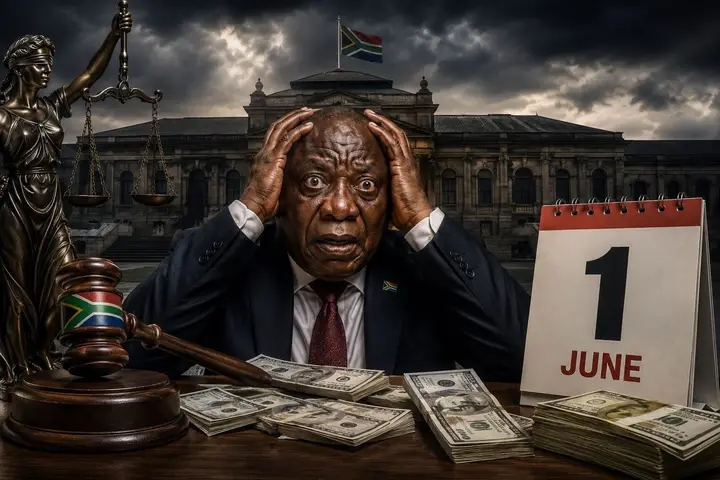
RAMAPHOSA FACES CONSTITUTIONAL WAR AS IMPEACHMENT COMMITTEE LAUNCHES
1 June 2026 | 17:30
By Paul Hattingh
On Monday afternoon, 1 June 2026, South Africa entered constitutional territory never before seen in the democratic era.
For the firest time since 1994, a sitting South African President formally appeared inside an active Section 89 impeachment structure under the Constitution.
Not political theatre.
Not social media outrage.
Not opposition slogans.
A real constitutional impeachment committee.
And from Monday onward, South Africa’s constitutional crisis moved from theory into institutional reality.
Inside Parliament’s Good Hope Chamber in Cape Town, the official 31-member Section 89 Impeachment Committee held its first sitting.
That moment alone was historic.
But what happened next revealed just how politically explosive this process is becoming.
MAKASHULE GANA ELECTED AS COMPROMISE CHAIRPERSON
The committee’s first major battle centred around one issue:
Who would control the process?
After voting, Makashule Gana of Rise Mzansi was elected chairperson.
Gana received 19 votes.
Dr Wonderboy Mahlatsi of the UAT received 12.
The result was politically significant for several reasons.
Gana emerged as a compromise candidate.
He was reportedly nominated by the ANC but also received support from the DA and several other parties.
That detail matters enormously.
The ANC clearly understood that placing one of its own directly in charge of proceedings involving Cyril Ramaphosa could severely damage the credibility of the process.
At the same time, the ANC also did not want to lose total influence over the structure.
The result was a GNU-style compromise.
And that compromise reveals the new political reality of South Africa:
The ANC no longer fully controls the constitutional system like it once did.
THIS IS NOW A REAL CONSTITUTIONAL IMPEACHMENT PROCESS
Many South Africans still misunderstand what happened on Monday.
Ramaphosa was not impeached.
He was not removed from office.
The committee itself cannot remove him.
Its role is investigative.
But that does not reduce the seriousness of what has now begun.
The committee now moves into the next phase of the process:
Finalising terms of reference.
Establishing procedural rules.
Setting timelines and programmes of action.
Reviewing evidence and documentation.
Hearing submissions.
Potentially calling witnesses.
Evaluating the 2022 Section 89 Panel findings.
Making recommendations to the National Assembly.
That process could stretch over weeks or even months, especially while parallel court battles continue.
And this is where the real constitutional pressure now begins.
THE PHALA PHALA SCANDAL NEVER DISAPPEARED
The crisis traces back to the February 2020 burglary at Ramaphosa’s private Phala Phala game farm near Bela-Bela.
According to widely reported allegations, approximately $580,000 in foreign currency was stolen from the property.
The money was allegedly hidden inside furniture, including sofas.
Former State Security Agency head Arthur Fraser later laid criminal complaints that exploded publicly in 2022.
Ramaphosa has consistently maintained the money came from a legitimate buffalo sale to Sudanese businessman Mustafa Hazim.
But the scandal immediately triggered explosive constitutional and ethical questions:
Why was such a large quantity of foreign currency allegedly stored privately on a game farm?
Why was the theft allegedly not immediately reported through normal SAPS channels?
Why were presidential security structures allegedly involved?
Were suspects unlawfully detained or interrogated?
Was state power used for private interests?
Did the Presidency violate executive ethics obligations?
Those questions never disappeared.
They were politically contained.
Until now.
THE SECTION 89 PANEL CHANGED SOUTH AFRICAN POLITICS
In 2022, Parliament established an Independent Panel chaired by retired Chief Justice Sandile Ngcobo alongside Judge Thokozile Masipa and Advocate Mahlape Sello.
Its mandate was narrow but politically explosive:
Determine whether prima facie evidence existed that Ramaphosa may have committed serious misconduct or violated the Constitution sufficiently to justify a full impeachment inquiry.
The panel concluded that such prima facie evidence did exist.
That finding changed everything.
Not because it proved guilt.
It did not.
The panel was not a criminal court.
It did not convict Ramaphosa.
But for the first time in democratic South African history, a formal constitutional mechanism concluded that sufficient grounds existed to justify deeper investigation into the conduct of a sitting President.
THE ANC SHIELDED RAMAPHOSA IN 2022
In December 2022, the ANC-majority National Assembly voted against advancing the impeachment process.
The motion failed roughly 214 to 149.
For many South Africans, that vote reinforced the belief that party loyalty had once again overridden constitutional accountability.
The opposition exploded in response.
EFF.
ATM.
DA.
Multiple parties argued Parliament had politically protected Ramaphosa despite the seriousness of the findings.
But the matter did not die.
It moved to the Constitutional Court.
And that is where the constitutional earthquake began.
THE CONSTITUTIONAL COURT REOPENED THE ENTIRE PROCESS
On 8 May 2026, the Constitutional Court delivered one of the most politically explosive judgments since 1994.
The Court ruled that Parliament’s handling of the Section 89 process had been unconstitutional.
The earlier National Assembly decision that halted the impeachment route was effectively invalidated.
Most importantly, the Court ruled that the matter must proceed to an impeachment committee unless the panel report itself is successfully set aside on judicial review.
That single sentence fundamentally changed South African politics.
Because it created two simultaneous constitutional tracks:
Parliament now has a constitutional duty to proceed.
Ramaphosa still retains the right to challenge the panel report in court.
Those two battles are now unfolding at the same time.
RAMAPHOSA IS NOW FIGHTING FOR POLITICAL SURVIVAL
Around 25 to 26 May 2026, Ramaphosa launched a judicial review application in the Western Cape High Court.
The application reportedly exceeds 63 pages.
His legal team argues:
The panel exceeded its mandate.
The panel relied improperly on hearsay evidence.
Incorrect legal standards were used.
Findings extended beyond the original complaints.
A major part of Ramaphosa’s legal strategy attacks the panel’s reliance on allegations linked to Arthur Fraser.
Ramaphosa continues to deny wrongdoing.
He denies money laundering.
He denies violating his oath of office.
He denies criminal conduct.
And he has stated clearly that he does not intend resigning.
At the same time, he has threatened urgent legal action if Parliament continues while judicial review proceedings remain pending.
But there is a major constitutional problem for him.
The Constitutional Court already anticipated judicial review proceedings.
And crucially, the Court did not automatically suspend Parliament’s constitutional obligations.
That means the committee continues unless a court specifically intervenes.
As of Monday evening, no interdict had been granted.
The process therefore continues in parallel with the court challenge.
THE TWO-THIRDS MAJORITY REMAINS THE MASSIVE FINAL HURDLE
One of the most important realities in this crisis is often misunderstood.
The committee itself cannot remove Ramaphosa.
Even if the committee eventually recommends impeachment, the final decision would still require a two-thirds majority in the National Assembly.
That means at least 267 votes out of 400 MPs.
That is an enormous constitutional threshold.
And it explains why many analysts believe the process may ultimately become more politically damaging than constitutionally fatal.
Because even if serious misconduct findings emerge, actual removal remains extremely difficult without:
major ANC fractures,
GNU breakdown,
or large cross-party realignment.
The impeachment process therefore threatens Ramaphosa politically long before it threatens him numerically.
THE GNU NOW FACES ITS BIGGEST STRESS TEST
This crisis also represents one of the first truly major constitutional stress tests for the Government of National Unity.
The DA has publicly welcomed Gana’s appointment as a sign of procedural independence.
The ANC insists it is following constitutional obligations.
EFF and ATM figures continue pushing aggressively for speed and maximum pressure.
And behind the scenes, every party is calculating political risk.
Because this process now touches everything:
ANC internal factional warfare.
GNU stability.
Investor confidence.
Constitutional legitimacy.
Judicial authority.
Public trust in institutions.
The political pressure on the GNU could intensify dramatically if the process escalates further.
SOUTH AFRICA’S INSTITUTIONS ARE NOW UNDER GLOBAL SCRUTINY
International investors are watching this carefully.
South Africa already faces:
weak economic growth,
electricity instability,
municipal collapse,
infrastructure decay,
severe unemployment,
rising public debt,
violent crime,
and declining institutional trust.
Now add presidential impeachment instability on top of that.
Markets hate uncertainty.
And the deeper concern is no longer merely Phala Phala itself.
The concern is whether South Africa’s constitutional institutions can withstand severe political stress without broader instability.
That is now the real test facing the country.
THIS MAY BECOME ONE OF THE DEFINING CONSTITUTIONAL MOMENTS SINCE 1994
This is no longer merely about Cyril Ramaphosa.
It has become a test of South Africa’s constitutional order itself.
Can Parliament act independently from party machinery?
Can constitutional accountability survive political pressure?
Can the judiciary remain fearless?
Can the ANC survive another legitimacy crisis?
Can the GNU survive internal fracture lines?
Can South Africa prove that even the Presidency remains subject to constitutional scrutiny?
Monday’s sitting did not conclude the crisis.
It officially opened the next chapter.
⭕ DISCLAIMER
This article is an opinion and political analysis piece based on publicly available information, parliamentary proceedings, Constitutional Court developments, court filings, media reporting, and public statements available as of 1 June 2026.
President Cyril Ramaphosa denies wrongdoing, denies criminal conduct, denies money laundering, denies violating his oath of office, and has not been convicted of any crime relating to the Phala Phala matter.
The Section 89 Panel did not make criminal findings or determine guilt. It assessed whether prima facie grounds existed for further parliamentary investigation under constitutional procedures.
The impeachment committee process is investigative and procedural in nature. Any eventual removal of a President would still require a constitutionally mandated two-thirds parliamentary vote.
This article does not constitute legal findings, criminal conclusions, or factual declarations of guilt. It is political commentary and constitutional analysis regarding an ongoing public matter of major national importance.⭕