
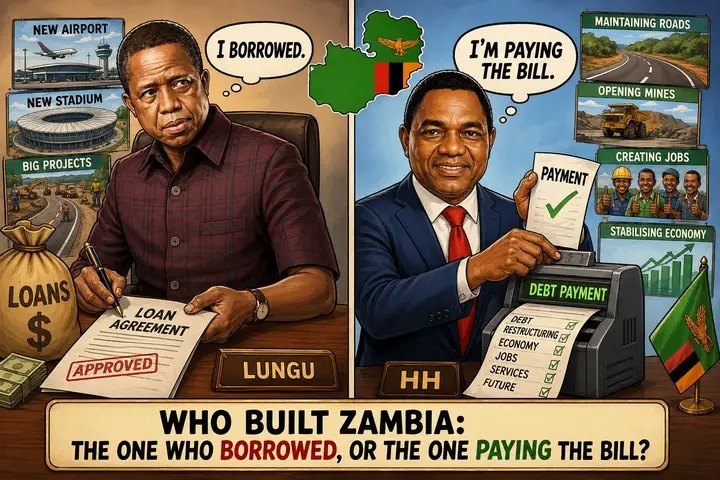
WHO BUILT ZAMBIA? THE BORROWER OR THE BILL PAYER?
WHO BUILT ZAMBIA? THE BORROWER OR THE BILL PAYER?
There is a man who built a stadium. There is another man making sure the stadium still belongs to Zambia. Know the difference.
The “chipani people” love to remind Zambians of the airports, the roads, the stadia, the bridges. His supporters wave these projects like trophies. And yes, the concrete is real. The structures stand. But here is the question nobody on that side wants to answer: built with whose money, on whose terms, and at what cost?
THE BORROWED GLORY
The Chipani governed Zambia from 2011 to 2021 and presided over one of the most reckless borrowing sprees in the country’s history. Zambia’s external debt ballooned from around $3 billion to over $17 billion by the time they left office. Eurobonds were issued. Chinese loans were signed. Infrastructure contracts were awarded at inflated prices. And the bills? Those were quietly pushed forward, left for someone else to deal with.
In 2020, Zambia became the first African country to default on its sovereign debt during the pandemic era. Not because of pandemic alone. Because the books were already broken before the pandemic arrived.
So when the Chipani points at Kenneth Kaunda International Airport and says “I built that,” the honest answer is: you did not build it. You mortgaged it.
WHAT DEFAULT ACTUALLY MEANS
This is where the conversation gets serious and Zambians need to pay attention.
When a country defaults on loans backed by national assets, creditors do not simply write letters. They pursue what they are owed. There were genuine fears, backed by legal frameworks in those loan agreements, that Zambia’s key revenue generating assets were at risk.
ZNBC. Gone.
ZESCO. Gone.
Kafue Gorge. Gone.
Kenneth Kaunda International Airport. Gone.
Not confiscated dramatically in the night. But tied up in litigation, arbitration, and asset freezes that would have crippled the state’s ability to function. Zambia was heading toward a situation where the lights, the airwaves, and the power were no longer fully ours to control.
That is not building a nation. It’s like playing “Kandeke”
THE MAN PAYING THE BILL
Hakainde Hichilema inherited a country in financial cardiac arrest. His administration did not get to announce glamorous groundbreakings in the first year. Instead, the work was unglamorous and absolutely necessary: debt restructuring negotiations with the G20 Common Framework, the IMF, bilateral creditors, and commercial bondholders.
In 2023, Zambia reached a landmark debt restructuring deal, the first country to complete the process under the G20 Common Framework. It was a painful, complicated, diplomatically exhausting process. But it was done.
Roads are now being maintained rather than just built and abandoned. The PPP Framework is in full swing too. Mines are being reopened under frameworks that return more revenue to Zambians. Jobs are being created through investments that do not come loaded with opaque conditions. The economy is being stabilised rather than stimulated through borrowing that future generations will pay.
This is not as photogenic as a ribbon cutting. But it is the difference between owning a country and leasing it.
THE REAL QUESTION
Building infrastructure with borrowed money and leaving the country in default is not development. It is decoration on a sinking ship.
The man who builds you a house and then hands the bank a mortgage (Loan)you cannot afford has not given you a home. He has given you a foreclosure waiting to happen.
Chipani borrowed. Zambia defaulted. HH is making sure Zambia does not lose what was built. That is not a small thing. That is EVERYTHING.
So the next time someone asks who built Zambia, ask them a better question: who nearly gave it away? And who is making sure we keep it?
____
© Zambian Angle