
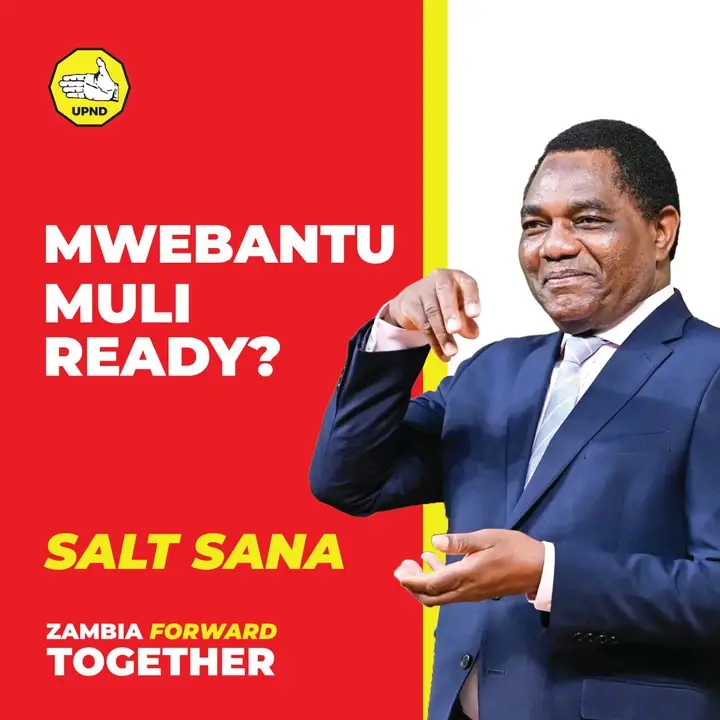
THE SHIFTING SLOGANS: FROM “BALLY WILL FIX IT” TO “SALT SANA”
THE SHIFTING SLOGANS: FROM “BALLY WILL FIX IT” TO “SALT SANA”
In 2021, President Hakainde Hichilema of the United Party for National Development (UPND) campaigned under the powerful slogan “Bally will fix it.”
This resonated with a populace weary of perceived misgovernance and economic stagnation under the previous Patriotic Front (PF) administration.
The slogan offered a clear and compelling promise of restoration and improvement, tapping into a widespread desire for decisive leadership capable of addressing systemic issues.
The electorate, yearning for tangible change, responded positively to the direct and actionable pledge that “Bally will fix”.
The perception at the time was that President Hichilema, with his business acumen, would be able to steer the nation towards good governance, and social cohesion.
The emphasis was on mending what was broken, implying a clear diagnosis and a confident prognosis for the nation’s ailments.
Five years later, he has switched from the “Bally will fix” slogan to the “Salt sana” or “More salt” slogan, a significant departure from the directness of his 2021 campaign slogan.
How can you prematurely abandon the “fix it” slogan when you have yet to fix the problems you promised to fix?
What is the point of putting “Salt sana” on problems you have not fixed?
The ambiguity in the “Salt sana” slogan is purely political, uninformed by reality on the ground given the continued existence of profound national issues that were central to the “Bally will fix it” promise.
The shift from a slogan of “fixing it” to “salt sana” – enhancement or addition – suggests a failure to confront the scope of the problems inherited and exacerbated.
The economic figures are particularly illustrative of this challenge.
The PF left behind a debt burden of $12 billion accumulated over a decade.
However, President Hichilema has significantly increased borrowing by $16 billion over the course of five years, bringing the total national debt to around $28 billion.
This rapid accumulation of debt directly contradicts the spirit of “fixing it.”
He found Zambia’s performance on the corruption perceptions index to be marginally improved, but it slipped to 104th out of 143 countries in the Rule of Law Index.
This decline in the rule of law ranking has weakened institutional frameworks that are crucial for accountability and fairness in governance hence the fight against corruption is targeting former leaders while sparing his government officials.
Contrary to the promise of a more rights-respecting society, reports from human rights organizations including the United Nations Human Rights, Amnesty International, and Human Rights Watch indicate an increase in human rights abuses since 2021.
This explains the systematic erosion of constitutionalism, as well as the arbitrary arrests of citizens, journalists, and activists, which limit dissent and political opposition while also fueling the casual erosion of the independence of government wings, the suppression of peaceful assembly, and restrictions on media freedom.
This erosion of rights is not fixing but a systemic decay within institutional frameworks essential for good governance.
The slogan “Bally will fix it” was inextricably linked to the cost of living, but the harsh reality on the ground tells a different story.
The price of mealie meal, has seen a dramatic increase, rising from around K170 when PF left to K300 per bag.
Similarly, the cost of fertilizer has surged from K750 to K1,100.
Even fuel prices, which he found at K17 per litre have since climbed to K26 per litre placing immense pressure on household budgets, eroding purchasing power and contributing to economic hardship, contrary to the “fix it” promises.
Furthermore, tribalism, a divisive force in politics, has intensified, confirming founding father Kenneth Kaunda’s fears that President Hichilema would divide the country.
Instead of “fixing” tribalism by fostering national unity, the political landscape has seen a rise in ethnic tensions, further fragmenting society and undermining social cohesion.
Instead of promoting Christian values as a Christian nation, underworld fraternities such as Freemasonry can operate freely.
These are not minor issues that require “Salt sana” – a sprinkle of “more salt”; they are fundamental systemic problems demanding robust, structural solutions.
Therefore, a move from “Bally will fix it” to “Salt sana” is an acknowledgement that the “fix it” promise has failed, leading to a desire for a less confrontational slogan.
While electoral slogans are inherently designed to resonate with the electorate and inspire confidence, the justification for the transition from “Bally will fix it” to “Salt sana” is not immediately apparent when considering the worsening national challenges.