
THE PATRIOTIC FRONT BORROWED FOR INFRASTRUCTURE
By Given Mutinta
THE PATRIOTIC FRONT BORROWED FOR INFRASTRUCTURE
When President Hakainde Hichilema was assenting to Bills at State House, he used the platform to deliver a sharp critique of the Patriotic Front (PF), accusing them of poor economic management during their tenure.
He openly questioned the PF’s intentions and priorities, stating that his own government had the difficult task of stabilizing an economy that, in his view, had been seriously mismanaged by the previous administration.
In a pointed rhetorical jab, President Hichilema asked the PF, “Our colleagues are saying they want to come back. To do what?”—a remark clearly aimed at undermining their economic credibility and record.
One of the central issues to his criticism was the alleged “unnecessary borrowing” during the PF’s decade in power.
Implicitly, President Hichilema’s argument is that the PF contracted approximately $9 billion in external debt over ten years, and left behind local debts totalling about K178 billion.
According to President Hichilema, this indebtedness created a significant burden for his administration, forcing them to prioritize painful fiscal adjustments rather than focus on new development initiatives.
Despite these disingenuous criticisms, the legacy of the PF era is marked by a substantial number of large-scale infrastructure projects, many of which were financed through both local and external borrowing.
These tangible achievements include the:
1. Lusaka Decongestion Project.
2. Kazungula Weighbridge.
3. Kenneth Kaunda International Airport.
4. Simon Mwansa Kapwepwe International Airport.
5. Harry Mwanga Nkumbula International Airport.
6. Kafue Gorge Lower Hydro Power Station.
7. A comprehensive Rural Electrification Program.
8. Construction of 500 health posts and hospitals.
9. About 500 primary schools.
10. About 110 secondary schools.
11. About 12,000 housing units for security wings.
12. Around 1,009 communication towers that have significantly improved national connectivity.
13. Sioma Bridge.
These projects are more than just statistics or graphs on paper like those celebrated by UPND cadres; they are visible and long-term assets that have helped Zambia modernise and grow economically.
By investing in airports, bridges, roads, energy facilities, schools, and hospitals, the PF laid down infrastructure that serves as the backbone of development for future generations.
Their borrowing was channelled into projects that the public can see and utilize daily—evidence that borrowed funds were invested into the nation’s long-term growth.
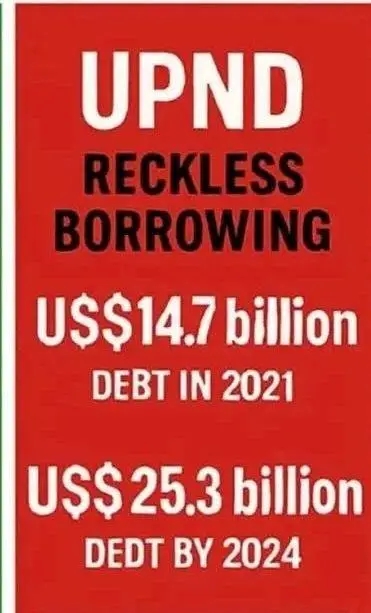
In contrast, the current government led by President Hichilema and the United Party for National Development (UPND) has also engaged in significant borrowing.
In less than five years, external debt has climbed to $28.1 billion, and local debt has reached K252 billion—outpacing the PF’s borrowing rate.
This new debt has not resulted in any major, visible infrastructure developments.
Unlike the PF era, when borrowing translated into tangible projects, the UPND’s borrowing is used for consumption and recurrent expenditures, rather than for new infrastructure or productive investment.
While President Hichilema often frames his administration as one fixing the financial excesses of the PF, the reality is that his government’s debt accumulation has been even more rapid, with little to show for it in terms of new assets
The PF can confidently point to tangible assets as proof of their borrowing’s impact.
In contrast, the UPND’s borrowing has not produced similar public benefits despite having borrowed more than PF in a short period.
As a result, President Hichilema’s criticism of the PF lacks the moral grounding, given that his administration has followed a more aggressive, borrowing path than PF—yet without delivering the same visible outcomes.
It is thus imprudent for President Hichilema to portray his government as a corrective to PF’s excesses, when the facts show that his administration’s borrowing record is even more significant, with far less to show for it.