
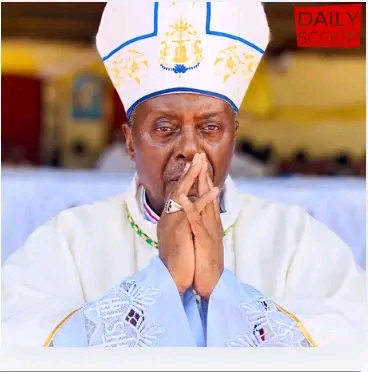
BISHOP LUNGU URGES HICHILEMA TO HOLD PRIVATE TALKS ON JUSTICE, TOLERANCE AND RECONCILIATION
BISHOP LUNGU URGES HICHILEMA TO HOLD PRIVATE TALKS ON JUSTICE, TOLERANCE AND RECONCILIATION:
CHIPATA Diocese Bishop George Lungu has called for a private meeting with President Hakainde Hichilema to discuss concerns surrounding justice, political tolerance, the rule of law and the treatment of opposition figures following the August 13 election.
Bishop Lungu said Zambia needed less political confrontation and more honest dialogue among political, religious and civic leaders, particularly at a time when political tensions have raised concerns among sections of the public.
In a statement issued on Tuesday, the bishop said the proposed meeting would provide an opportunity for religious and civic leaders to engage President Hichilema and Government officials in a respectful and private discussion about issues affecting the country’s democratic and social fabric.
He stressed that the initiative was not intended to embarrass the President, attack the Government or serve as a platform for political confrontation.
Instead, the proposed engagement would allow the delegation to present concerns raised by citizens while also listening to the Government’s perspective.
Bishop Lungu said recent developments had left some citizens concerned about the direction in which the country was heading.
He said the Christian community, particularly the Catholic Church, could not remain silent when issues involving human dignity, freedom of expression, accountability and the rights of opposition supporters were raised.
According to Bishop Lungu, every citizen should be treated first and foremost as a human being, regardless of their political affiliation.
He maintained that the Constitution must remain supreme over both Government and political parties and that access to justice should not depend on a person’s political identity.
“No government is above the Constitution,” Bishop Lungu said, while cautioning that political disagreements should never be allowed to become justification for hatred, intimidation or violence.
At the same time, he urged opposition political parties not to regard their status as opposition as an exemption from the law.
The bishop said the country’s focus should go beyond determining who had won or lost politically and instead examine whether Zambia remained a nation where citizens could peacefully express grievances, seek justice and participate in political life without fear.
Bishop Lungu further said the Church’s role was not to take sides in political contests.
He said the Church should neither become an extension of the opposition nor serve as a cheerleader for those in government.
However, he stressed that political neutrality should not be mistaken for silence.
According to Bishop Lungu, the Church has a responsibility to speak out whenever human dignity, justice, peace and the rule of law are threatened, while holding both those in government and those in opposition accountable.
He said the proposed meeting would be conducted privately and respectfully, with the delegation expected to raise what he described as “difficult but necessary questions” concerning justice, political tolerance, the treatment of opposition figures and the independence and accessibility of institutions of justice
The delegation, he added, would also listen to the concerns and explanations of Government.
Bishop Lungu said genuine reconciliation could not be achieved by simply blaming one side while expecting the other to surrender.
He said the objective should instead be “truth in charity, justice with mercy, and dialogue in the service of peace”.
The bishop also referred to the biblical Letter of James, which encourages people to be quick to listen, slow to speak and slow to anger.
As part of the process, Bishop Lungu has proposed a preparatory meeting involving religious leaders, traditional leaders, professionals, elders, young people, academics, civil society representatives and other citizens committed to peace, justice and reconciliation.
Following consultations and what he described as prayerful discernment, he said the stakeholders could consider an informal and private meeting with President Hichilema and appropriate Government representatives.
To preserve the non-partisan nature of the initiative, Bishop Lungu proposed that the delegation should primarily comprise religious and civic representatives rather than political actors.
He said this would demonstrate that the initiative was a moral and civic appeal aimed at promoting dialogue rather than another front in Zambia’s political competition.
Bishop Lungu also warned that unresolved political tensions could develop into deeper national divisions if they were not addressed.
He referred to the experiences of other countries where prolonged political grievances had contributed to hatred, violence and civil conflict, saying Zambia should avoid following such a path.
The bishop said forgiveness was an important part of reconciliation, but stressed that forgiveness should not mean ignoring legitimate grievances or abandoning the pursuit of truth and justice.
“Forgiveness requires truth. Reconciliation requires justice. Peace requires healing,” he said.
He urged Zambians to look beyond the familiar political division between winners and losers and instead consider the kind of country they want to leave for future generations.
Among the questions he raised were whether political power should be exercised as a form of service rather than domination, whether citizens should be able to seek justice without fear, and whether political disagreements should turn fellow citizens into permanent enemies.
Bishop Lungu also stressed that Zambia belongs to all its citizens and not simply to whichever political party occupies State House at a particular time.
Political parties, he observed, come and go, but the nation remains.
For now, the bishop’s proposal remains an invitation rather than a concluded engagement. Whether the meeting takes place, who eventually participates and what issues are ultimately discussed will depend on consultations with religious, civic and Government representatives.
His central appeal, however, is for dialogue, justice, restraint and reconciliation.
Bishop Lungu wants the Church and civic leaders to create space for meaningful conversation between citizens and those in power, with the hope that political differences can be addressed through dialogue rather than confrontation.
The proposed initiative therefore places emphasis on listening, accountability and reconciliation as Zambia navigates the political tensions that have emerged following the election.