
WICKNELL CHIVAYO, MERCENARIES, MONEY AND GUNS: THE QUESTIONS EMERGING AFTER HIS DEATH
WICKNELL CHIVAYO, MERCENARIES, MONEY AND GUNS: THE QUESTIONS EMERGING AFTER HIS DEATH
By Brilliant Pongo
The death of Wicknell Chivayo in a helicopter crash on 30 September 2026 has opened an extraordinary second chapter to his public life.
While Zimbabwe mourns, celebrates and debates the flamboyant businessman who became famous for luxury cars, presidential friendships and extravagant gifts, older stories are being retrieved from court archives, books and newspaper reports. At the same time, newer allegations involving Sudanese gold, weapons trafficking and regional political networks are beginning to circulate.
Some of these stories are documented.
Some are allegations.
And some are merely dots that commentators are presently trying to connect.
Those distinctions matter.
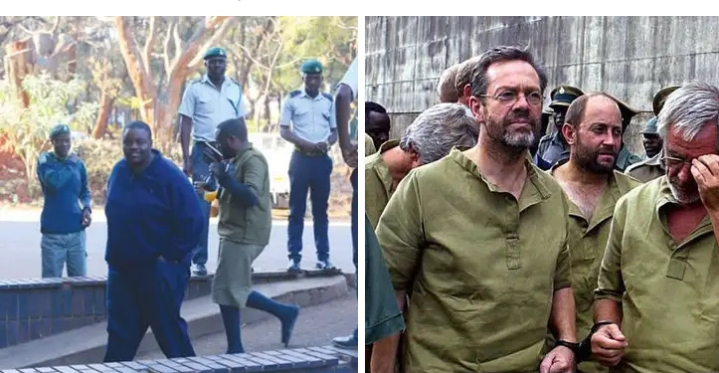
What is beyond dispute is that the Chivayo story did not begin with Rolls-Royces, private aircraft and photographs with presidents. Long before the public knew “Sir Wicknell”, there was Chikurubi Maximum Security Prison — and inside Chikurubi was one of Africa’s most notorious mercenary figures.
THE CHIKURUBI CONNECTION: SIMON MANN
Simon Mann was no ordinary prisoner.
The former British SAS officer and mercenary was one of the central figures in the failed 2004 attempt to overthrow Equatorial Guinea’s President Teodoro Obiang.
Mann was arrested in Zimbabwe in March 2004 together with a group of men linked to the coup operation. The affair subsequently implicated a network of wealthy and well-connected figures.
One of the best-known was Sir Mark Thatcher, son of former British prime minister Margaret Thatcher. Thatcher later pleaded guilty in South Africa to violating the country’s anti-mercenary legislation after admitting that he financed a helicopter connected to Mann’s operation, although he maintained that he had initially understood the aircraft to be for legitimate purposes. (The Guardian)
And inside Chikurubi, Mann met Wicknell Chivayo.
The relationship is not internet mythology.
Mann himself wrote about Chivayo in his memoir Cry Havoc, describing the two men sharing the same prison section. Later reporting documented that their friendship continued after prison, including a photograph of Mann and Chivayo together in 2013. (BBC Mirror)
That alone does not make Chivayo a mercenary.
But what Mann alleged Chivayo offered to do is far more intriguing.
THE 9MM PISTOL ALLEGATION
In Cry Havoc, according to Zimbabwean reporting published in 2016, Mann claimed that Chivayo had offered to arrange for a 9mm pistol to be smuggled onto the aircraft that would eventually transport Mann from Zimbabwe to Equatorial Guinea.
Mann wrote that Chivayo claimed to have access to weapons and contacts among airport security personnel.
According to the reported passage, Chivayo supposedly told Mann that if he discovered Mann was being flown to Equatorial Guinea, he could arrange for a 9mm pistol to be hidden aboard the aircraft. (Herald Online)
That is an extraordinary allegation.
Had such a plan actually been implemented, it could potentially have turned an extradition flight into an armed escape or hijacking attempt.
But this is precisely where responsible reporting becomes important.
I have found no evidence that the gun was actually placed aboard an aircraft. I have also found no court judgment establishing that Chivayo attempted to arm Mann or participate in Mann’s coup conspiracy.
The claim comes from Simon Mann’s own account.
It should therefore be described as Mann’s allegation, not as a proven criminal act by Chivayo.
Nevertheless, it tells us something significant about the circles in which Chivayo found himself during his imprisonment.
This was not simply a young businessman serving time alongside ordinary inmates.
He had developed a relationship with one of the most famous mercenary commanders of the post-Cold War period.
MONEY LAUNDERING AND THE THREE YEARS IN PRISON
The reason Chivayo was at Chikurubi in the first place is itself an important part of the story.
Zimbabwean court reporting records that Chivayo was convicted in 2005 of money laundering involving approximately R837,000.
He received a five-year sentence, of which two years were conditionally suspended, leaving an effective three-year prison term.
Court reporting in 2016 stated explicitly that by then Chivayo had fully served the three-year sentence. (Herald Online)
His appeal became stuck for years because parts of the original court record went missing. Judicial notebooks were eventually discovered and attempts were made to reconstruct the record. (Herald Online)
Later accounts report that the conviction was eventually overturned, an important qualification when discussing his criminal history today. (The Times)
That does not erase the historical fact that he spent years inside Chikurubi.
And it was there that the paths of the future multimillionaire businessman and Simon Mann crossed.
THEN CAME THE BILLION-DOLLAR WORLD
After prison, Chivayo’s life changed dramatically.
He emerged as a businessman involved in government-linked infrastructure and energy projects and eventually became one of the most publicly extravagant figures in Southern Africa.
He cultivated relationships with political leaders across the continent and publicly displayed meetings with presidents in Zimbabwe, Kenya, Tanzania, Malawi, Uganda and elsewhere. (Kenya Insights)
But questions about the origins and movement of his wealth never disappeared.
One of his largest controversies involved the Gwanda solar project.
His company Intratrek Zimbabwe became embroiled in years of litigation and criminal proceedings concerning money paid for preliminary works on the proposed 100MW solar project.
Importantly, those proceedings did not simply end with a conviction.
The litigation moved through different courts, including a 2020 Supreme Court ruling that reversed an earlier High Court intervention and allowed criminal proceedings to continue. Chivayo and Intratrek were subsequently acquitted in later proceedings. (ZimLII)
So again, allegations and outcomes must not be confused.
THE NEW SUDAN GOLD ALLEGATIONS
Then came another allegation in 2026.
Kenyan activist Boniface Mwangi publicly accused Chivayo of involvement in moving gold originating from Sudan through Dubai and of involvement in the movement of money linked to Kenyan political interests.
Those claims received significant attention.
But the critical fact is this:
No publicly produced flight manifest, customs record or financial trail has so far substantiated the allegation.
Kenya Insights, while reporting Mwangi’s accusations, itself acknowledged that the allegations lacked that documentary evidence. (Kenya Insights)
Chivayo had previously rejected allegations that he was involved in gold smuggling, telling Nehanda Radio in 2024 that the only gold he travelled with was contained in his expensive watches. (Nehanda Radio)
Therefore the Sudan-gold story remains an allegation.
But Sudan is where the story becomes more complicated.
Because gold, weapons and the Sudanese war increasingly overlap.
THEN CAME MALAWI — AND THE GUNS
On 1 October 2026 — just one day after Chivayo’s death — Malawi’s Anti-Corruption Bureau arrested former Malawi Defence Force commander General Paul Valentino Phiri.
The ACB says Phiri faces five counts connected with abuse of office and dealing in property linked to terrorism.
More significantly, the bureau says the charges arise from allegations that Phiri facilitated illegal arms trafficking during June and July 2025. (Anadolu Ajansı)
The Platform for Investigative Journalism in Malawi had already been investigating claims that military officials facilitated the movement of heavy weapons intended for rebels fighting in Sudan.
According to PIJ’s reporting, allegations contained in intelligence material described weaponry arriving in Malawi, paperwork identifying the Malawi Defence Force as the supposed end-user and the cargo subsequently being moved onwards through Chad towards Sudan.
The alleged cargo reportedly included heavy weaponry and possibly missiles. (PIJ Malawi)
These allegations are now considerably more serious because a former army commander has actually been arrested and charged.
But here comes the crucial question:
Where is Wicknell Chivayo in this story?
At present, the answer is: not in the official charges that have been made public.
The Malawi Anti-Corruption Bureau has not publicly identified Chivayo as the financier, supplier or participant in the alleged weapons shipments.
Malawi24, examining the emerging theories after Chivayo’s death, reached essentially the same conclusion: there are circumstances worth investigating, but the available evidence does not establish that Chivayo financed the arms shipments. (Malawi24)
That distinction cannot be ignored.
WHY HIS MALAWI CONNECTION IS ATTRACTING ATTENTION
The reason people are nevertheless asking questions is timing and access.
Chivayo met former Malawian president Lazarus Chakwera in July 2025 — the same broad period in which the alleged arms-trafficking activities are said to have occurred.
He also maintained links with Peter Mutharika and other African leaders.
But meeting presidents is not evidence of arms trafficking.
A photograph is not a shipping manifest.
Presidential access is not proof of criminal conspiracy.
To establish Chivayo’s involvement investigators would need evidence connecting him directly to the aircraft, weapons, procurement documents, payments, intermediaries or recipients.
So far, that evidence has not been publicly produced. (Malawi24)
THE STRANGE THREAD RUNNING THROUGH THE STORY
What makes the emerging story fascinating is not that every allegation can presently be proved.
It is the strange recurrence of similar themes across two decades.
In the mid-2000s Chivayo was imprisoned alongside Simon Mann — a mercenary caught in Zimbabwe while preparing an operation connected to the overthrow of an African government.
Mann later alleged Chivayo offered to arrange a weapon aboard his extradition aircraft.
Twenty years later Chivayo was moving in presidential circles across Africa while allegations circulated involving Sudanese gold.
Then, immediately after his death, a former Malawian military commander was arrested in a completely separate investigation concerning alleged illegal arms shipments linked to the Sudan conflict.
These facts create questions.
They do not yet create proof.
DO NOT CONNECT DOTS THAT EVIDENCE HAS NOT CONNECTED
There is a temptation after the sudden death of a powerful and mysterious businessman to turn every coincidence into conspiracy.
That would be irresponsible.
There is currently no demonstrated evidential chain proving that Chivayo supplied weapons to Sudanese rebels, financed the Malawi weapons route or operated an arms-trafficking organisation in East or Southern Africa.
There is also no evidence I have found establishing that Chivayo was part of Simon Mann’s original Equatorial Guinea coup operation.
What we can say is considerably more precise.
Chivayo served prison time following a money-laundering conviction that he later challenged.
He formed a documented friendship with convicted mercenary Simon Mann.
Mann alleged Chivayo offered to help him obtain a gun during his extradition crisis.
Chivayo subsequently developed extraordinary political and commercial access across several African states.
He faced numerous accusations involving money, state contracts and procurement — some of which ended in acquittals or favourable court decisions.
He was later accused by political activists of involvement in Sudanese gold movements, allegations for which no public documentary trail has yet been produced.
And an arms-trafficking investigation is now unfolding in Malawi concerning weapons allegedly destined for actors in Sudan — but Chivayo has not been publicly charged or officially identified by Malawian investigators as part of that operation.
That is where the evidence currently stops.
And perhaps that is where serious journalism should begin.
Because the question after Wicknell Chivayo’s death should not simply be:
“Was he involved?”
The better questions are:
Who financed the alleged weapons?
Who owned or chartered the aircraft?
Who produced the end-user certificates?
Which banks processed the payments?
Who were the intermediaries between Malawi, Chad, Sudan and the financiers?
And do any of those records lead back to companies, associates or financial structures connected to Wicknell Chivayo?
Until those questions are answered through documents, banking records, flight logs, court evidence and official investigations, the guns-and-gold story remains one of the most intriguing — but still unproven — chapters emerging from the extraordinary life of Wicknell Chivayo.