
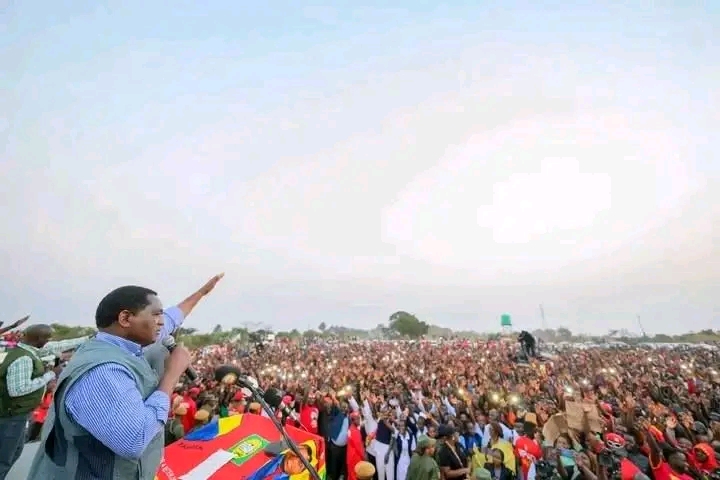
Campaigns Tighten as Zambia Enters Final Four Days
EVENING WIRE | Campaigns Tighten as Zambia Enters Final Four Days
Zambia enters the final four days before Thursday’s General Election with the two leading presidential campaigns sharpening their closing messages, while a controversy surrounding Tonse Pamodzi Alliance Presidential Affairs Chairperson Binwell Mpundu has introduced a security dimension into an already tense final stretch.
Mpundu was reported to police today over a video published on his Facebook page in which a person appearing to be him declared: “Our lives are at stake. We are ready to die. And we are ready to kill.” Democratic Advocates for Good Governance Executive Director Fabian Mutale said he reported the matter because the remarks could generate fear ahead of polling day.
Police have since confirmed investigations into the matter.
There has, however, been an important development. Mpundu has denied making the video, saying his Facebook account had been compromised and describing the recording as artificial intelligence-generated. In a notice subsequently published on the same page, he wrote: “I have been made aware of a video posted on my page which is all artificial intelligence as I have not made any such video.”
He further claimed he had not personally accessed the page for days after being removed by a hacker and apologised for the sentiments contained in the recording.
That denial changes the evidential position but does not settle it. The original recording circulated from a page bearing Mpundu’s name before being removed. Mpundu says it was fabricated and his account compromised. Police are investigating. Until investigators establish whether the recording is authentic, manipulated or AI-generated, its contents should therefore not be presented as established remarks by Mpundu.
The episode is significant beyond one politician. Zambia is approaching an election in an information environment where authentic recordings, manipulated material and political propaganda can circulate almost simultaneously. Four days before voting, verification becomes part of election security. A false video can provoke supporters. A genuine video dismissed as AI can also evade accountability. The police investigation should establish the facts quickly and communicate them clearly.
Away from the controversy, President Hakainde Hichilema spent Sunday campaigning in Luapula Province, continuing the UPND’s strategy of returning to districts left outside his first provincial sweep. He addressed meetings in Chembe, Milenge and Chipili, carrying essentially the same closing argument into one of the territories where the UPND historically performs more weakly: continuity of government programmes in exchange for another mandate
In Chembe, Hichilema promised “more social cash transfer, more cash for work, more business opportunities, more health facilities”, alongside clean water and expanded agricultural support. In Milenge, the emphasis remained social protection, schools, health facilities and agriculture. And in Chipili, he asked voters not to “look back”, promising continued investment in roads, education, health and farming.
The location matters as much as the message. Luapula has traditionally belonged to the PF side of Zambia’s electoral map. Hichilema is therefore spending some of his final campaign hours not simply defending established UPND territory but attempting to reduce opposition margins in historically difficult ground. With the presidential election decided nationally, losing narrowly can sometimes matter almost as much as winning overwhelmingly elsewhere.
Brian Mundubile, meanwhile, spent part of Sunday emphasising the religious identity of his presidential campaign. Mundubile and running mate Makebi Zulu attended a service at Tabernacle of David in Lusaka, where the NRPUP candidate committed himself to completing the National House of Prayer and restoring the Ministry of Religious Affairs and National Guidance should he win Thursday’s election.
Mundubile also disclosed that he and Zulu regularly pray while campaigning, including praying in tongues while travelling on their campaign vehicle. His campaign linked the commitment to what it calls the Chitambo Declaration, through which the pair has sought to place Christianity and Zambia’s declaration as a Christian nation within their political programme.
The contrast between the two campaigns is becoming clearer as time runs out. Hichilema is closing predominantly on the language of continuity, government programmes and delivery, asking voters to protect what his administration describes as gains since 2021. Mundubile is presenting change, while combining economic promises with a stronger appeal to Christian identity and the political legacy of programmes associated with the former PF administration.
Neither message decides Thursday’s election on its own. The rallies are almost over. The endorsements are almost exhausted. The arguments on social media will soon become secondary.
What matters now is organisation.
With 8,786,300 registered voters, the contest enters the stage where campaigns must convert political sympathy into actual ballots. Strongholds must produce turnout. Weaker provinces must produce respectable margins. Polling agents must reach stations. Candidates must persuade undecided voters. And the institutions responsible for the election must keep the process peaceful and credible.
Sunday therefore leaves Zambia with two stories moving simultaneously. The candidates are making their final arguments for power. The country, meanwhile, is confronting the risks surrounding the contest itself, including violence, inflammatory rhetoric and now questions about AI-generated political content.
Four days remain.
The campaign can still generate noise. Only the ballot will generate a government.
The People’s Brief | Ollus R. Ndomu; Francine Lilu