
The U.S. Still Controls Iraq’s Oil Proceeds After the Gulf War
The U.S. Still Controls Iraq’s Oil Proceeds After the Gulf War
___
How the U.S. Maintains Financial Control Over Iraq
Did you know that the U.S. continues to hold and leverage Iraq’s oil proceeds, primarily by depositing the revenue from Iraq’s oil sales into an account for the Central Bank of Iraq at the Federal Reserve Bank of New York?
Whenever Iraq sells oil, the money goes straight to a bank account in New York. Now tell us, how did Iraq agree to this?
This happened after Saddam Hussein was overthrown. The U.S. military took over to administer the country. Although it was eventually forced to withdraw, it made sure that any oil sold by Iraq would continue to go into a special account in New York. This arrangement gives Washington significant structural control and financial influence over Iraq’s economy.
⸻
Recent Actions and Context
Blocked Shipments
The U.S. Treasury Department blocked a cargo plane carrying nearly $500 million in cash—proceeds from Iraqi oil sales—intended for the Central Bank of Iraq.
Geopolitical Leverage
The hold on, and delayed cash shipments are intended to pressure Baghdad into dismantling Iran-backed militias operating in the country.
Financial Constraints
Because Iraq’s financial system is heavily dollarized and its currency is pegged to the U.S. dollar, Iraq relies on these shipments and the Federal Reserve accounts to pay government salaries and stabilize its economy.
⸻
Washington Summons Iraq’s Prime Minister
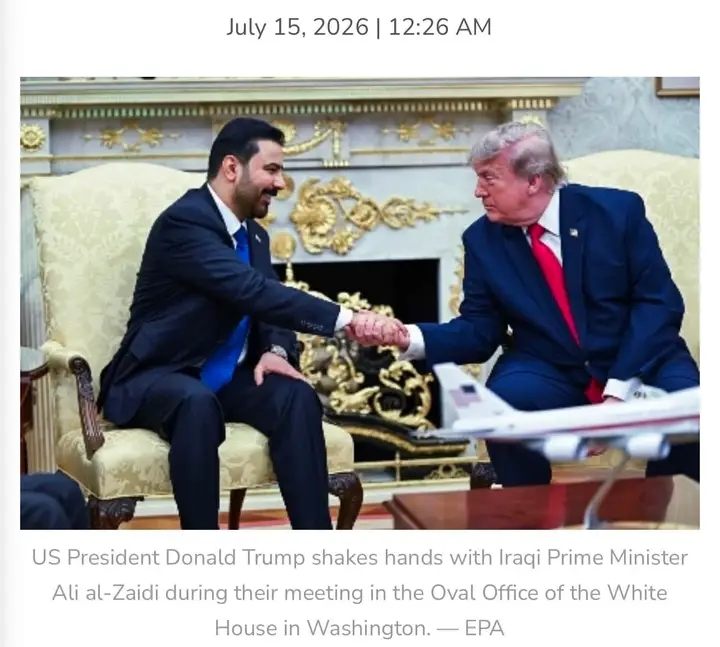
Iraqi Prime Minister Ali al-Zaidi was summoned to Washington, D.C., last week to rein in all the militias and begin cracking down on those that have been attacking U.S. forces.
This man got into power thanks to pressure from the Trump regime.
In late January 2026, Iraq’s dominant Shia political bloc, the Coordination Framework, nominated Nouri al-Maliki to return for a third term as prime minister following the country’s parliamentary elections. Donald Trump strongly rejected and vetoed the nomination of former Iraqi Prime Minister Nouri al-Maliki.
Can you believe a foreign country vetoing who can serve as the prime minister of another country? This is a clear violation of Iraq’s sovereignty.
But it didn’t matter. The U.S. controls the bulk of Iraq’s oil revenue.
However, the firm American veto effectively forced the Iraqi Shia bloc to abandon his nomination and pivot toward a compromise candidate to avoid devastating economic sanctions and a rupture with Washington.
This paved the way for the ascension of Ali al-Zaidi, a businessman with no previous political background, who became Iraq’s new prime minister and later traveled to Washington, D.C., to shift the U.S.-Iraq partnership toward an economic and energy-driven relationship.
⸻
After Returning From Washington
He came back from Washington, D.C., and issued this statement. He got the receipts from Washington.
Iraqi PM Vows Action After Drones Breach Kurdistan Region Airspace
Iraqi Prime Minister Ali al-Zaidi condemned an Iranian drone attack that breached the airspace over Erbil in Iraq’s northern Kurdistan region, his office said on Thursday, after multiple drones were intercepted and shot down.
“We have directed the relevant security agencies, in coordination with the Region’s security forces, to take all necessary measures to prevent the recurrence of such attacks and to thwart anyone attempting to harm the security of our noble Iraqi society, wherever they may be.”
Zaidi did not name those responsible for the drones.
Several blasts were reported on Wednesday near the U.S. Consulate in Erbil, triggering the activation of air defense systems around the diplomatic facility.
⸻
Iraq Is Not Under Military Occupation—But Its Economy Is
The U.S. still has a military presence in Iraq, and Iraq is no longer under military occupation, but its economy is under financial occupation.
How successive Iraqi governments have allowed the U.S. to control their oil proceeds is mind-boggling.
⸻
This Is What Iran Is Fighting Against
First came the invasion of Iraq over fake weapons of mass destruction. We now know those claims were false. The U.S. and its allies invaded Iraq, overthrew Saddam Hussein, and thousands of civilians were killed as a result of U.S. and European air strikes and bombardments during the 1990–1991 Gulf War and the years that followed.
The U.S. and Israel have repeated the same pattern with Iran, attacking a country that did not attack the United States. They have killed over 4,000 civilians and destroyed infrastructure, causing more than $1 billion in damages.
This is why Iran is demanding compensation and charging fees in the Strait of Hormuz to recover some of the losses caused by the destruction.
In this case, Iran can fight back, and that is why the U.S. is struggling.
The U.S. decimated Saddam Hussein’s army. Iraq is largely desert with few natural defensive barriers. They simply drove into the country, administered it, took control of the oil, and did whatever they wanted.
They cannot do that to Iran because Iran has the capability to fight back, assert itself, and defend its independence.
If Iran did not have missiles capable of striking back, they would have totally destroyed Iran, just as Israel has done in Gaza by destroying military installations to prevent retaliation.
⸻
This Is About Sovereignty, Not Religion
We support Iran not because it is Muslim, but because we believe every country has the right to pursue its independence and sovereignty.
The days of dominance, control, and imperialism—where the Caucasian, Anglo-Saxon, and Celtic powers dominated much of the world for over 400 years—are coming to an end.
They invaded Africa, China, and nations of Black, Brown, and Indigenous people. They extracted resources, invaded countries, took over governments, stole wealth, built their economies, and maintained global dominance.
⸻
The Global Power Struggle
What Iran, China, Cuba, and other countries are doing is challenging the global system of trade, commerce, finance, and resource extraction that has long been dominated by the United States and Europe.
They established institutions such as the World Bank and the IMF, while controlling strategic maritime choke points around the world, including in Africa and Somalia, where the U.S., France, the U.K., and other countries maintain military bases.
The U.S. is also competing with China for control of strategic waterways, including the Strait of Malacca and the South China Sea. Controlling these waterways allows a nation to dominate global trade, dictate energy supply chains, and project military power.
This is exactly what is happening in the Strait of Hormuz, a strategic chokepoint through which nearly 30% of the world’s seaborne oil flows.
The war with Iran has two levels.
First, regional control. Israel wants to ensure Iran never rises as a dominant regional power.
Second, global competition. The U.S. does not want China to rise as a global power because China depends heavily on Iranian energy supplies.
People need to understand these two fronts to understand what is really happening.
⸻
The Rise of BRICS
This is why we now have the rise of BRICS—Brazil, Russia, India, China, and South Africa—in an effort to break the hold of U.S. dominance over global finance, trade, and commerce.
Once you understand both the regional and global dynamics, you will become less emotional about this war and better understand what is really going on.
⸻
The Bigger Picture
Iran is fighting for the little man—for Blacks, Africans, people of darker skin, and those who have long been considered inferior—because they are standing up to two superpowers: the United States and Israel, the most powerful military force in the Middle East.
Not because of religion, but because of freedom, justice, sovereignty, and independence.