
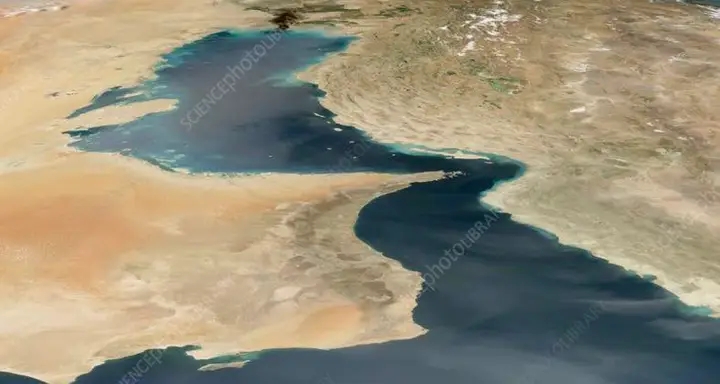
Washington had spent the week demanding Iran publicly declare the strait open. Iran’s answer was to declare it shut
THREE ROUNDS OF AIRSTRIKES. 140 TARGETS. ELEVEN SHIPS.
That is the arithmetic of American power in the Strait of Hormuz this week. And it is merciless.
On 1 July, 41 vessels transited the strait. By 9 July, 17. On 10 July — after the United States had struck some 140 targets across Iran and reimposed sanctions — just 11 ships moved, against a peacetime norm of nearly 90 a day. The more ordnance America expends, the fewer ships sail. If military power is meant to produce political outcomes, what we are watching in the Gulf is not a demonstration of power. It is a demonstration of its futility.
Then overnight Saturday, Tehran removed all ambiguity. After a warning shot at a ship on an “unapproved” route, the IRGC Navy declared the Strait of Hormuz CLOSED until further notice — “until the end of American interference in the region.” No vessel permitted to transit.
Washington had spent the week demanding Iran publicly declare the strait open. Iran’s answer was to declare it shut. America’s answer was a third round of strikes. The strait stayed shut.
On Sunday, Ebrahim Rezaei, spokesman of the Iranian Parliament’s national security committee, declared that Iran has “taken control of the Strait of Hormuz with power.” The Western reflex is to dismiss this as bluster. But the test of control is not who claims it. The test is: whose permission do ships actually need to move?
Look closely at where the surviving traffic goes. Iran demands vessels use a northern route through waters it controls, cleared by the IRGC Navy. Ships using the southern corridor — the one protected by the US Navy — are the ones being attacked. It was Iranian strikes on three tankers on that southern route which collapsed the ceasefire this week.
Sit with that. The ships that transited safely did so under Iranian administration. The ships under American protection got hit. The Fifth Fleet was patrolling a corridor the world’s shipowners learned to avoid — while the corridor that functioned was the one Tehran policed. First Iran annexed the strait’s traffic management — a Strait Authority, regulations, tolls dressed up as insurance. Now it has shut the door entirely. A power that can throttle a strait to a trickle, then close it “until further notice” at a moment of its choosing, is displaying the full meaning of control: the dial turned down, then off. And the power to close a waterway on your own terms is the same power to reopen it on your own terms.
Why can’t the world’s most powerful navy reopen a strait? I spent over three decades in international shipping law — marine insurance, P&I, war risk — and here is what the admirals cannot tell the White House: straits are not opened by firepower. They are opened by underwriters.
No shipowner sails without war risk cover. And underwriters do not price American press releases — they price Iranian intent. When Tehran shows it can strike any vessel at a time of its choosing, premiums do the rest. Owners divert. Carriers reroute around the Cape. America can destroy every radar and missile battery it can find — it cannot destroy the possibility of the next strike, and it is the possibility the insurance market prices. A navy can win every engagement in the strait and still lose the strait. The battlespace that matters is not the water. It is the Lloyd’s slip.
Blockade in April. Sanctions. The June MOU. Now three rounds of airstrikes. Every instrument in the American toolkit has been tried — some twice — and after each cycle, Iranian administration of Hormuz emerges more entrenched. I wrote when the MOU was signed that it was an American strategic defeat dressed as diplomacy. This week, events scored that judgment.
And the quiet tell? Brent crude sits at roughly $76. The market is not pricing catastrophe. It is pricing a new normal — Hormuz as an Iranian-governed waterway, punctuated by American strikes that change nothing. Normalisation does not arrive with a treaty. It arrives with an adjustment.
The rules-based order’s most sacred plumbing — freedom of navigation, guaranteed by international law and the US Navy — has failed its most important test. What replaces it is older and harder: control belongs not to whoever has the biggest navy, but to whoever will bear the most pain in the narrowest water.
Tehran did not declare control of Hormuz this week. It demonstrated it — and then described what it had demonstrated. In the era now opening, power is not declared. It is demonstrated. And this week, in the world’s most important strait, only one side demonstrated anything at all.
—
The full analysis — including the pattern of failed American coercion from the February closure to this week’s collapse — will be on my Substack. Subscribe free at limtean.substack.com so you never miss it.
-Lim Tean