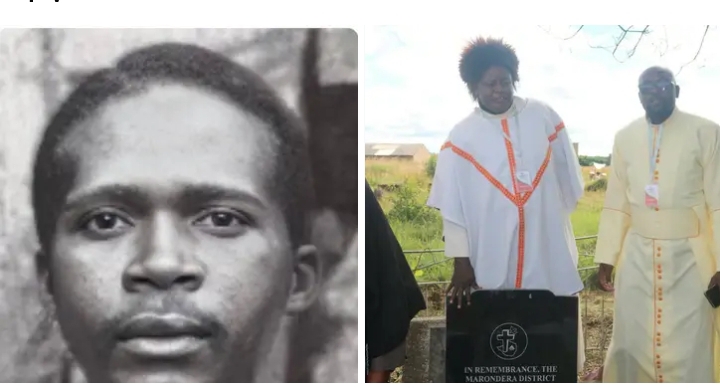
BERNARD MIZEKI, MOLELI THE FORGOTTEN CHIMURENGA 1 HEROES
1896. Mashonaland was on fire.
The white settlers called it the “Mashonaland Uprising.” The people called it Chimurenga I — the first war of liberation. Spirit mediums spoke, chiefs rose, and farms burned. In the middle of it, three men died for their faith. Two are remembered. One is almost gone.
Bernard Mizeki was Anglican. He had come from Portuguese East Africa, now Mozambique, to be a catechist near modern Marondera. He was not Shona. He was not Ndebele. He was a foreign teacher who lived among the people, taught them to read, and spoke of a new God.
Modumedi Moleli was Wesleyan (Methodist). He was one of eight African catechists sent up from South Africa in May 1892. Three were Basotho. Moleli was one of them. Like Mizeki, he had come to teach the Gospel to the local people at the new Mission stations.
Both men died in 1896, killed in the Uprising. The reason the records give is the same for both: because of their association with the White Settlers, they were eliminated. To the rebels, a mission teacher looked like an extension of the Company, of Rhodes, of the Pioneer Column that had marched in six years earlier. Even though both Mizeki and Moleli were Black Africans from outside Mashonaland, their cloth collars and Bibles marked them.
Mizeki died near Marondera. His grave became a shrine. Anglicans still go there. Books were written about him. He became “the Anglican Martyr of Zimbabwe.”
Moleli died nearby, at about the same time. He too has a book now. He is remembered as the Wesleyan martyr of Chimurenga I.
There was a third. James Anta, a Xhosa from the Eastern Cape, son of a chief, once a noted hunter before his baptism. He was the man left alone at Hartleyton Mission, west of the Great Dyke, near Chief Zvimba’s kraal in 1892. He built a pole-and-dakha school-church, taught children, and stayed when the other seven catechists left. In 1935 a Wesleyan historian wrote: “It may be found that James Anta and his family were the first in the noble army of martyrs, who thus suffered for their faith.”
Yet almost no one says his name today. The Mission farm is gone. So is the memory.
But Mizeki and Moleli remain, linked forever by 1896.
Imagine them for a moment. Mizeki, teaching under trees near Marondera, writing in his notebook while children copied letters in the dust. Moleli, a Mosotho far from home, speaking in a new tongue at Epworth before being sent out. Both believing, like Rev. Shimmin who pegged Hartleyton in December 1891, that “our flag is now waving within a few days journey of the River Zambezi” — a forward movement of the Gospel into “millions of heathen.”
They did not see the war coming. The people around them were still bound to nyangas, ancestral spirits, and old fears of mission houses where, as one chief’s nephew said, “they make an extraordinary amount of noise… and natives are put to death.”_ The missionaries thought they were winning souls. History shows they overestimated. It was only after Chimurenga was crushed that traditional life broke open and the churches filled.
In June 1896 the spirit mediums said: drive out the settlers. And anyone close to them. Mizeki was killed. Moleli was killed. Their mission stations were abandoned.
Today schoolchildren in Zimbabwe learn Mizeki’s name. Fewer know Moleli’s. Almost none know Anta’s.
Two foreign catechists. One war. Two graves remembered, one forgotten. All three died for the same faith, in the same year, for the same reason.
That is the story of Mizeki and Moleli: missionaries caught between a Gospel they carried and a war they did not start.
FV