
The Vanishing: How Black Argentina Was Erased From a Nation’s Story
An account by Rev Walter Mwambazi
🇦🇷 The Vanishing: How Black Argentina Was Erased From a Nation’s Story
An account by Rev Walter Mwambazi
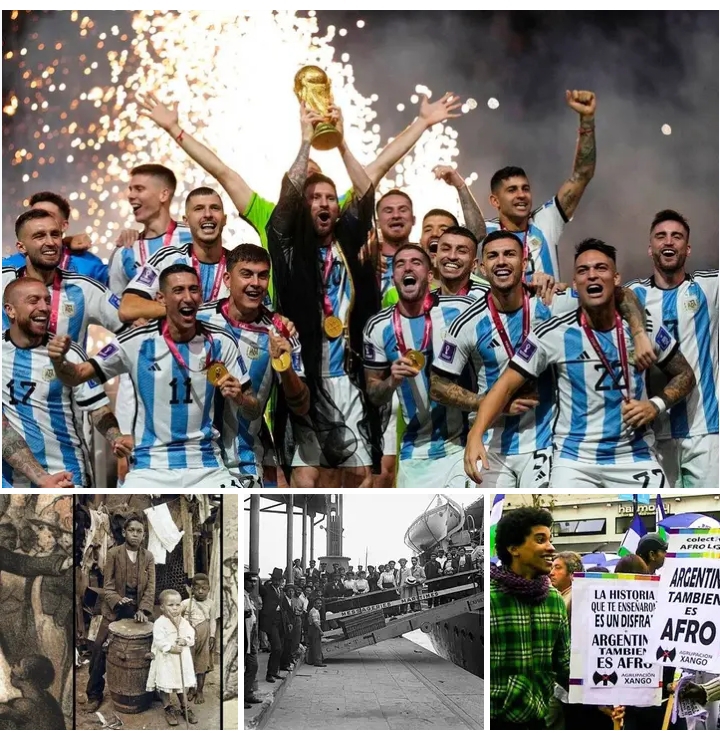
If you’ve ever watched Argentina play football and wondered why you don’t see a single Black face on that pitch, you’re not imagining things. There’s a reason. And it’s not because Black people “don’t play football” or “never lived there.” The truth is far heavier than that — Argentina once had a large, visible Black population, and today that community has almost disappeared.
Not by accident. Not by coincidence. But through a long, painful mix of war, disease, policy, and a national project that quietly pushed Black identity out of sight.
This is the part of Argentina’s story that rarely makes it into the glossy tourism brochures.
As always, this is why I quote Chinua Achebe’s prophetic statement, “until the lion learns to write, the tale will always glorify the hunter”! It was Bob Marley in that great song “Buffalo Soldier” where he states “if you know you history, then you would know where your coming from, and you wouldn’t have to ask me, who the hell do you think I am!”
Let’s dig in, shall we?
✍🏾 1. Before the Disappearance: Argentina Was Once Deeply African
It shocks people to learn that in the late 1700s, Buenos Aires was over one‑third Black. Africans arrived through the port, built communities, formed brotherhoods, served in militias, and shaped the early culture of the city. They were musicians, artisans, soldiers, and workers who helped build the foundations of the nation.
Tango — yes, the national dance — carries African fingerprints.
Gaucho culture? Also influenced by Afro‑Argentines.
Early Argentine society was far more diverse than the modern image suggests.
Black people were not a footnote.
They were part of the story from the beginning.
✍🏾 2. The Wars That Took a Heavy Toll
When Argentina fought for independence, Afro‑Argentines were recruited in huge numbers. Many didn’t volunteer — they were taken from enslaved households and sent straight to the front lines. Mortality rates were brutal. Some historians estimate that half of the Black male population died during these wars.
Then came the Paraguayan War, one of the bloodiest conflicts in the region. Once again, Black soldiers were heavily represented in the infantry. Once again, the losses were devastating.
War didn’t erase the population entirely, but it created a demographic wound that never healed.
✍🏾 3. Yellow Fever: The Epidemic That Hit the Poor Hardest
In 1871, yellow fever swept through Buenos Aires. The disease didn’t care about race, but poverty did. The poorest neighborhoods — where many Afro‑Argentines lived — were hit the hardest. Thousands died. Entire communities vanished almost overnight.
Those who survived often fled the city or were displaced permanently.
It was another blow to a population already struggling to recover from decades of war.
✍🏾 4. The Whitening Project: A Nation Rebranding Itself
By the late 1800s, Argentina’s leaders had a vision:
Turn Argentina into a “European nation.”
They didn’t hide this. They wrote it openly. They promoted it proudly.
Between 1880 and 1930, more than six million Europeans arrived — Italians, Spaniards, Germans, Poles. The government encouraged European immigration while quietly discouraging African and Indigenous identity.
Census categories for “Black” were removed. Schools taught that Argentina was a white nation. Afro‑Argentines were encouraged to identify as “mestizo” or simply “white.” This wasn’t genocide by guns. It was erasure by paperwork, policy, and silence.
A demographic collapse became a cultural disappearance. 🥺
✍🏾 5. The Quiet Removal From Culture and Memory
As the decades passed, Afro‑Argentine contributions faded from public memory. Tango’s African roots were downplayed. Black gauchos were written out of cowboy folklore. Textbooks stopped mentioning the Black militias that fought in the independence wars.
A national myth took hold:
“Argentina has no Black people.”
And once a myth becomes part of national identity, truth becomes inconvenient. Very much so even to this day. Many Argentines have no idea about this part of their history—unfortunately.
✍🏾 6. Why You Don’t See Black Players on the National Team
This is the part people notice first.
Argentina’s football team reflects the country’s demographics. Afro‑Argentines today make up less than 1% of the population. Most Black people in Argentina today are recent immigrants from Senegal, Nigeria, Cape Verde, and other African countries — not descendants of the original Afro‑Argentine population.
So the absence of Black players isn’t about ability, it’s about history. A nation once rich in African heritage spent 150 years actively erasing it. 🥺
✍🏾 7. The Revival: A Community Reclaiming Its Place
In recent years, Afro‑Argentine activists have pushed back against the myth of disappearance. The 2010 and 2022 censuses finally counted Afro‑descendants again. Imagine that. A country where an entire demographic was deliberately excluded. Cultural groups are reviving African‑Argentine music, dance, and traditions. Scholars are documenting the forgotten chapters of the nation’s past.
The community is small, but it’s no longer silent. Argentina is beginning to remember.
✍🏾 8. Why This Story Matters
This isn’t about blaming modern Argentines, ut’s about telling the truth. I deliberately chose to mention this as the FIFA World Cup shines another spotlight on that great footballing nation that even I love. Add Messi to that too! Yet it is what it is.
It reminds us that:
👉🏾 Blackness in Latin America is deeper than stereotypes.
👉🏾 Erasure doesn’t always come with violence — sometimes it comes with silence.
👉🏾 Remembering is an act of justice.
Argentina’s Black population didn’t vanish, it was written out. There is another appropriate word for it, expunged! In case you didn’t know, the Mother Church did something similar to history back in 1492 via an official Papal Bull. It was part of what is known as “The Doctrine of Discovery” and this went hand in hand with the power given to the conquistadors to bring the known world under the subjection of the church. A truly dark history for another day.
Thankfully now, slowly, the true history of Afro-Argentinians is being written back in.
Share this story and let your friends learn something new!