WHO DECIDES WHERE A FORMER PRESIDENT IS BURIED?
Picture this:
A former President dies.
Government says: “Bring the body home. State funeral. Embassy Park.”
The family says: “Aah, not so fast.”
The repatriation is stopped. Mourning ends. The family says the former President will be buried in South Africa.
And just like that, Zambia’s funeral becomes a court case in South Africa.
That was the Edgar Lungu saga.
It exposed a very awkward question: when a former President dies, who ultimately decides how and where he is buried: the State or the family?
Zambia had actually wrestled with part of this question before.
In People v Secretary to the Cabinet, Ex parte Kaweche Kaunda (HP 768 of 2021), concerning the funeral of our first President, Dr Kenneth Kaunda, the Court described a state funeral as a public funeral governed by State protocol and meant to honour a person of national significance.
The Court went further, observing that even where a personal wish points in another direction, public interest may, in an appropriate case, prevail.
Good principle.
But there was still a problem: where was the clear statutory rule?
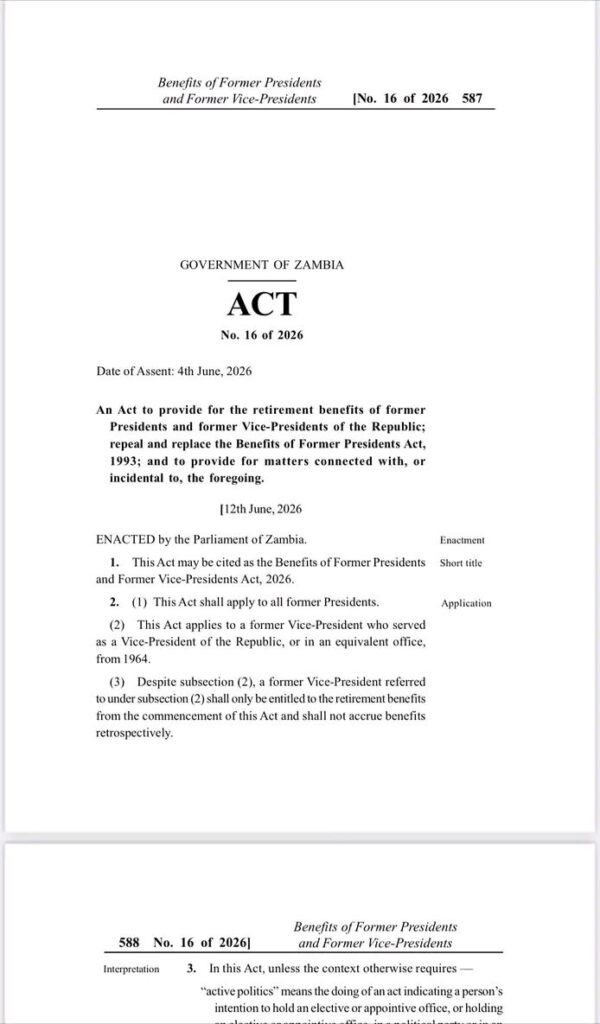
Enter the Benefits of Former Presidents and Former Vice-Presidents Act, 2026.
Section 8 now provides that a former President “shall be buried at a burial site designated by the Government within the Republic.”
And the funeral shall be conducted according to State protocols.
That little word “shall” is doing heavy lifting.
It means we are no longer relying only on tradition, Government practice or arguments about what is in the public interest.
Parliament has written the rule down.
And that is a very good thing.
Because the Lungu saga showed us what happens when the legal position is not sufficiently clear. Government, family, political parties and lawyers can end up arguing over funeral arrangements while the nation is waiting.
A funeral is already emotional enough.
We don’t need a side order of litigation and constitutional gymnastics.
The beauty of the new provision is therefore not merely that it tells us what happens after the death of a former President.
It tells us before the next death.
The next time a former President dies, the country should not have to start another episode of:
Government: “This is the programme.”
Family: “We have our own programme.”
Lawyers: “Let us go to court.”
And somewhere in the background, somebody is asking:
“So ba body is where?”
Section 8 brings clarity.
A former President is to be buried in Zambia at a Government-designated burial site, and the funeral is to be conducted according to State protocol.
Simple.
The moral of the story?
Sometimes the best way to prevent tomorrow’s argument is to write today’s rule.
And thanks God Parliament has now given us the answer.
So perhaps the next former President’s funeral can finally be just that:
a funeral.