
By Augustine Mukoka
SILENCE IS COMPLICIT: Where Is Former British Minister Sir. Tony Blair As Zambia’s Democracy Bleeds?
An OPEN LETTER to Former British Prime Minister Sir Tony Blair
4 September 2026
Dear Sir Tony Blair,
As indicated above, my name is Augustine Mukoka, a native of Zambia and a global citizen.
I write this open letter on the backdrop that you and your organization – the Tony Blair Institute for Global Change (TBI) have a relationship with Zambia in partnership with the United Nations Development Program (UNDP) particularly for the implementation of the digital transformation and economic development agenda.
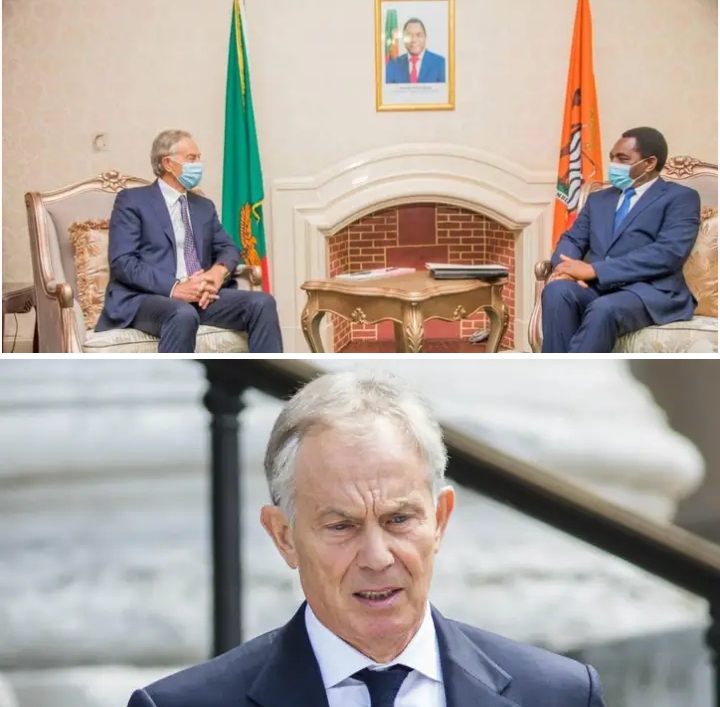
In September 2021, a few days following the election of Mr. Hakainde Hichilema, as Seventh Republican President, you visited Zambia and expressed optimism with the then “New Dawn” administration.
I have no doubt you are fully aware of the circumstances prevailing in Zambia five years after your first visit with particular interest the disputed and illegitimate second term of Mr. Hichilema post the August 13, 2026 presidential and general elections.
The events that have unfolded leading to the current political crisis is impossible for anyone, including yourself, to ignore.
You are a former Prime Minister of the United Kingdom and an internationally prominent advocate of governance reform whose name and institutions are publicly associated with Mr. Hichilema and his administration.
For that reason, you ought to take interest in the prevailing situation in Zambia following a fiercely disputed election which resulted in serious allegations concerning electoral integrity, political intimidation, arbitrary detention, extrajudicial killing, violence and the conduct of state security institutions.
Conspicuously, you, Sir Blair, have remained silent.
Your relationship with Mr. Hichilema makes that silence particularly troubling. International figures who associate themselves with African leaders during periods of stability and acclaim cannot simply disappear when those governments face serious allegations of democratic backsliding or abuse.
Friendship cannot become a shield against accountability.
Sir. Blair, our democracy is bleeding. We are on the cusp of a frightening trajectory that borders on tribal disputes and we refuse to be the next Rwanda.
Your association with Mr. Hichilema does not, by itself, make you responsible for his government’s actions. But silence has political consequences.
When an influential statesman who advocates democracy and good governance remains silent while serious allegations surround a government with which he has been associated, people are entitled to ask what that silence means.
Where is your voice when opposition leaders Hon. Brian Mundubile, Hon. Makebi Zulu, retired Anglican Bishop Trevor Mwamba and their associates are detained in a maximum prison on trumped up charges of treason? Where is your voice when a former minister Hon. Mutotwe Kafwaya, a senior member of the opposition, is brutally murdered while Hon. Mundubile survives an assassination attempt when government security forces invade a private residence? Sir, where is your voice when the military is used to storm polling stations, manipulate votes and deny the citizens an opportunity to select leaders of their choice?
The seriousness of these allegations demands scrutiny — not indifference.
Mr. Prime Minister, Zambia has survived for decades as a remarkably peaceful multi-ethnic nation. That inheritance must never be gambled away.
When citizens begin believing that the military, police, electoral authorities, courts or civil service serve particular political or ethnic interests rather than the Republic, resentment can become something far more dangerous.
You have occupied one of the world’s most powerful political offices. You understand where polarization can lead.
Do not therefore become, through endorsement, institutional association or silence, a participant in anything capable of pushing Zambia toward ethnic confrontation.
Nobody wins such a conflict — not Hichilema, not the opposition, not Tony Blair, and certainly not Zambia.
Zambians are entitled to ask another uncomfortable question: What exactly is your interest in Zambia?
Is it peace, democracy, stronger institutions and improving ordinary lives—or is Zambia’s enormous mineral wealth part of the attraction?
You may mean well. And we appreciate your interest in our country. But where is your voice when our democracy is bleeding? You, of all people, know too well that there can never be peace in the absence of justice or development in the face of chaos.
Zambia possesses strategically important mineral resources at a time when copper and other critical minerals are increasingly central to global economic and geopolitical competition.
Relationships between African governments, foreign advisers, international institutions and commercial interests therefore deserve maximum transparency.
Zambia must never become a playground where international actors preach democracy publicly while privately prioritizing access, influence and resources.
The country’s minerals belong to Zambia. Its institutions belong to Zambia. Above everything else, Zambia belongs to Zambians.
Sir, if Mr. Hichilema is your friend and colleague, friendship should require uncomfortable truths.
Tell him political power is temporary. Tell him state institutions cannot become instruments for settling political disputes. Tell him allegations of unlawful detention, concocted treason charges, intimidation, violence and security-force involvement in political affairs require credible, independent investigation.
Mr. Prime Minister, sir, tell your friend that a disputed election cannot be legitimized through coercion. It must be resolved through evidence, transparency, due process and institutions whose independence commands public confidence.
And tell him that no leader should gamble Zambia’s peace merely to remain in State House or at his Community House.
Perhaps, since he is your friend, colleague, or associate, he may have already briefed you. Or you may have asked what is happening.
My question, Mr Prime Minister, is; do you support what is happening in Zambia?
If you believe Mr. Hichilema and his administration have conducted themselves properly, say so publicly. If you believe the allegations against his government are false, explain why.
But if you believe these allegations of electoral irregularities, arbitrary detention, extrajudicial killing, intimidation, security-force abuses or violence require independent investigation, then please, sir, find your voice and say so.
There can be no convenient middle ground where democracy is loudly promoted in conference halls but quietly abandoned when accountability becomes politically inconvenient.
Zambians deserve to know whether the principles promoted by international governance institutions apply universally — or only when convenient.
Sir Tony Blair, this is not a request to support Zambia’s opposition. It is a demand that you stand for principles you have repeatedly associated yourself with internationally: democracy, accountable government, functioning institutions and political stability
1. Call for transparency and preservation and independent scrutiny of relevant electoral evidence.
2. Call for credible investigation of alleged violence and abuses by state institutions.
3. Call for protection of opposition leaders, journalists, activists and ordinary citizens exercising lawful political rights.
4. Call for political disputes to be resolved through credible constitutional and judicial mechanisms rather than coercion.
5. And unequivocally warn every political actor against ethnic mobilization.
Therefore, if Mr. Hichilema has nothing to hide, transparency should not threaten him.
If the election withstands independent scrutiny, that scrutiny should strengthen its legitimacy.
If allegations against state institutions are unfounded, independent investigation provides an opportunity to establish that fact.
But silence answers none of these questions.
You have access to Mr. Hichilema that millions of ordinary Zambians do not have.
Use it responsibly.
When the history of this period is written, it will not merely identify those who exercised power. It will also remember the influential people who watched, understood the stakes — and chose whether to speak or not.
Sir Tony Blair, Zambia is asking: Where do you stand?
Break your silence.
Augustine Mukoka
Good Governance Advocate | Communications Specialist | Journalist
Tony Blair Institute for Global Change Hakainde Hichilema United Nations Human Rights United Nations U.S. Department of State: Bureau of African Affairs U.S. Department of State U.S. Embassy Zambia UK in Zambia UK Prime Minister European Parliament