
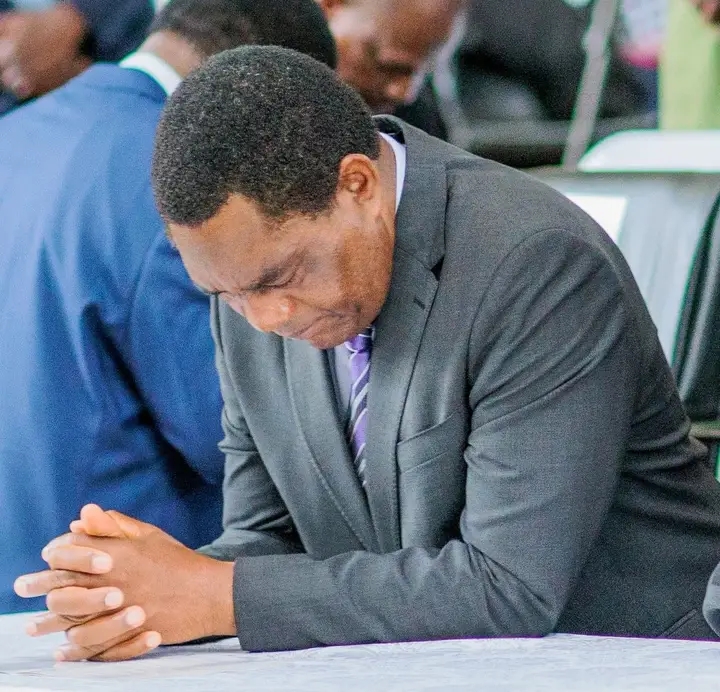
PRESIDENT HICHLEMA TO PETITION THE ELECTION OF BRIAN MUNDUBILE
By Given Mutinta
PRESIDENT HICHLEMA TO PETITION THE ELECTION OF BRIAN MUNDUBILE
In the grand theatre of Zambian politics, where power often teeters on razor-thin margins, a shadowy saga is unfolding—one that promises to shake the very foundations of the nation’s democracy.
Recent revelations have surfaced from a reliable source, exposing an extraordinary tale of desperation, deception, and defiant ambition centered on President Hakainde Hichilema as the countdown to the 2026 elections accelerates.
The drama begins with an unexpected prophecy: an Israeli intelligence organization, renowned for its rigorous analysis and incisive foresight, delivered a brutal forecast to President Hichilema.
The report was unequivocal—Brian Mundubile, his electoral adversary, stands poised to claim victory with an overwhelming margin exceeding 76 percent.
Such a decisive outcome left no room for doubt, no slender hope for a political miracle. The magnitude of this prediction struck President Hichilema like a thunderbolt.
Yet, beaten but unyielding, President Hichilema refused to surrender to fate.
His desperation morphed into audacity as he beseeched the Israeli intelligence operatives for assistance in rigging the election.
The reply was chilling and unequivocal: such manipulation was impossible, not only because the margin was insurmountably wide, but because any attempt to engineer fraud on this scale threatened to ignite civil unrest, even war— a catastrophe unthinkable for a nation yearning for peace and stability.
Undeterred by this stern warning, the source said that the President’s quest for subterfuge took a clandestine turn.
He turned to his closest political allies within the Tonse-Pamodzi Alliance, co-opting members who were to be dispatched to Dubai ostensibly to oversee the printing of ballot papers.
With a staggering bribe of $300 million dollars, he allegedly coerced these operatives to allow the production of pre-marked ballots – a sinister gambit aimed at disguising the rigging in plain sight.
However, the plot unraveled spectacularly when the scheme was exposed, the illicit funds were confiscated, and the investigation baton will be passed to anti-corruption agencies under a new government after the elections. This daring strategy is intended to ensure a thorough investigation and that the perpetrators face the consequences of the law.
When the $300 million dollars ploy for pre-marked ballot papers was doomed, the shadow play deepened, the stage moved to the Electoral Commission of Zambia to help alter the election results.
The Electoral Commission of Zambia informed the President that it is not possible to rig the elections because ballot papers and extra ballot papers were sealed in Dubai in front of all election observers, and that extra ballot papers can only be used with the permission of all political parties.
Disappointed, the source said that this made the President to turn to the judiciary—a linchpin in Zambia’s governance with a chilling plan: upon Mundubile’s inevitable victory, to file a petition challenging the results, with expectations that the judiciary would stall his swearing-in or mandate a rerun.
The judiciary’s response was as strategic as it was revealing—they advised the President to prime his supporters and the nation through relentless rhetoric at rallies, planting seeds of doubt by accusing Mundubile beforehand of intending to rig the elections. A psychological campaign to prepare the public mind for judicial delay or rerun.
In this web of intrigue and political maneuvering, one sees not merely a contest for power but President Hichilema’s profound refusal to accept the verdict of intelligence and the will of the electorate.
The desperation of a sitting President, caught between the stark reality of defeat and the temptation of subversion, reflects a pivotal moment for the country’s democratic journey.
The prudent path for President Hichilema, as illuminated by these revelations, would be an embrace of transparency and acceptance—acknowledging the intelligence forecasts without resorting to clandestine manipulations.
To fortify democracy, it would be wiser to prepare for a peaceful handover, championing the very principles he once espoused.
For in the crucible of leadership, resignation to facts does not signify weakness but fortitude and a commitment to national unity.